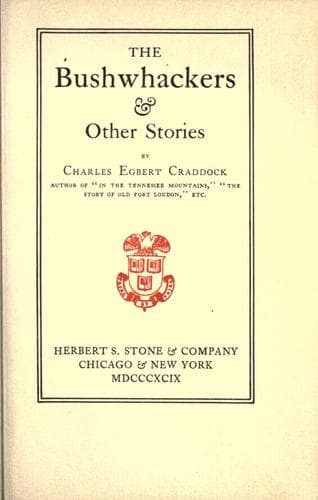
The bushwhackers & other storiesCraddock, Charles Egbert
General
The bushwhackers & other stories
Craddock, Charles Egbert
Mountain life -- Fiction; Tennessee -- Social life and customs -- Fiction
The end came on a hard-contested field, albeit only a thousand
or so were engaged on either side. The squadron, in one of those
wild reckless assaults of cavalry against artillery, for which the
Confederate horse were famous in this campaign, had gone to the attack
straight up a hill, while the muzzles of the big, black guns sent
forth smoke and roar, scarcely less frightful than the bombs which
were bursting among the horses and men riding directly at the battery.
It was hard to hold the horses. Often they swerved and faltered, and
sought to turn back. Each time Captain Bertley, with drawn sword,
reformed the line, encouraging the men and urging them to the almost
impossible task anew. At it they went once more, in face of shot and
shell. Now and again Hilary, riding in the rear rank, with his saber
at “the raise,” heard a sharp, singing sibilance, which he knew was a
minie-ball, whizzing close to his ear, and he realized that infantry
was there a little to one side supporting the battery. The rush,
the turmoil, the blare of the trumpets sounding “the charge,” the
clamor of galloping hoofs, of shouting men, the roar of cannon, the
swift panorama of moving objects before the eye, the ever-quickening
speed, and the tremendous sensation of flying through the air like
a projectile--it was all like some wild tempest, some mad conflict
of the elements. And suddenly Hilary became aware that he was flying
through the air without any will of his own. The horse had taken the
bit between his teeth, and maddened by the noise, the frenzy of the
fight, was rushing on he knew not whither, his head stretched out,
his eyes starting, straight up the hill unmindful of the trumpet now
sounding the recall and the heavy pull of the boy on the curb. Hilary
was far away in advance of the others when the line wheeled. A few more
impetuous bounds and plunges, and he was carried in among the Federal
guns, mechanically slashing at the gunners with his saber, until one
of the men, with a well-directed blow, knocked him off his horse with
the long, heavy sponge-staff. So it was that Hilary was captured. He
surrendered to the man with the sponge-staff, for the others were
busily limbering up the guns; they were to take position on a new
site--one less exposed to attack and very commanding. They had more
than they wanted in Hilary. He realized that as he was on his way to
the rear under guard. The engagement was practically at an end, and
the successful Federals were keenly eager to pursue the retreating
force and secure all the fruits of victory. To be hampered with the
disposition of prisoners at such a moment was hardly wise, when an
active pursuit might cut off the whole command. Therefore the few
already taken, who were more or less wounded, were temporarily paroled
in a neighboring hamlet, and Hilary, the war in effect concluded for
him--for the parole was a pledge to remain within the lines and report
Public-domain text, read in full here on John Shaqi.
Reviews
Reviews
No reviews yet
Be the first to share your thoughts on this work.
Join the Discussion
Join the discussion
Sign in to leave a comment or review.
Sign InorCreate an account