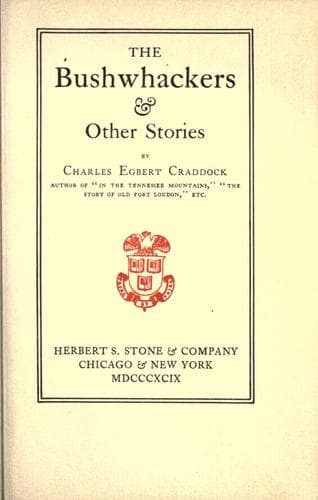
The bushwhackers & other storiesCraddock, Charles Egbert
General
The bushwhackers & other stories
Craddock, Charles Egbert
Mountain life -- Fiction; Tennessee -- Social life and customs -- Fiction
A thousand times that day Hilary wished, as they went on their journey
together, that he had never seen this man again. All Jack Bixby’s
methods were false, and it revolted Hilary, educated to a simple but
strict code of morals, to seem to share in his lies and his dubious
devices to avoid giving a true account of themselves. In fact their
progress was menaced with some danger. Having little to distinguish
them as soldiers, for the gray cloth uniform in many instances had
given place to the butternut jeans, the habitual garb of the poorer
classes of the country, they could be mistaken for citizens, peacefully
pursuing some rustic vocation, and this impression Bixby sought to
impose on every party who questioned them. He feared to meet the
Federals, because of their paroles, which showed them to be prisoners
and yet out of the lines, and he thought this broken pledge might
subject them to the penalty of being strung up by the neck.
“That air tale ’bout our bein’ in the lines an’ the lines shrinkin’
till we got out o’ ’em ain’t goin’ ter go down with no sech brash
fellers,” he argued with some reason, for the probabilities seemed
against them.
And now he dreaded an encounter with Union men, non-combatants, for
the same reason. He slipped off his boot at one time and hid the
paper under the sole of his foot. “Ef we-uns war ter be sarched they
wouldn’t look thar, mos’ likely.” And finally when they reached the
house of an aged farmer, who with partisan cordiality welcomed and fed
them, declaring that although he was too old to fight he could thus
help on the southern cause, Bixby took advantage of his host’s short
absence from the dining-room to strike a match which he discovered in a
candlestick on the mantel piece, for the season was too warm for fires,
and lighting the candle he held the parole in the flame till the paper
was reduced to a cinder; then he hastily extinguished the candle.
When once more on the road, however, Bixby regretted his decision. For
aught he knew they were still within the Federal lines. The Union
troops had doubtless been reinforced, for they were making a point of
holding this region at all hazards. He was a fool he said to have burnt
his parole--it was his protection. If he were taken now by troops not
in the extreme activities of resisting a spirited cavalry attack, who
had time to make his capture good, and means of transportation handy,
he would be sent off to Camp Chase or some other prison, and shut up
there till the crack of doom, whereas his parole rendered him for the
time practically free.
“Why didn’t you keep me from doin’ it, Hil’ry?”
Public-domain text, read in full here on John Shaqi.
Reviews
Reviews
No reviews yet
Be the first to share your thoughts on this work.
Join the Discussion
Join the discussion
Sign in to leave a comment or review.
Sign InorCreate an account