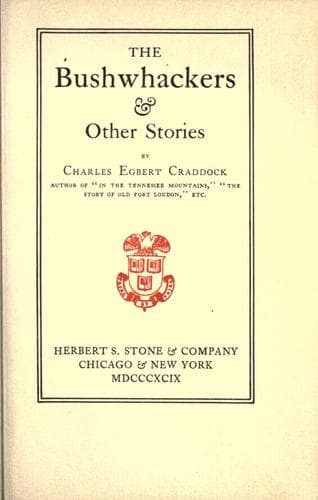
The bushwhackers & other storiesCraddock, Charles Egbert
General
The bushwhackers & other stories
Craddock, Charles Egbert
Mountain life -- Fiction; Tennessee -- Social life and customs -- Fiction
Looking across the gorge from where the three sat in the cabin porch,
there was visible on the opposite heights a great white frame building,
many-windowed and with wide piazzas. There were sulphur springs hard
by, and before the war the place was famous as a health resort. Now
it was a melancholy spectacle--silent, tenantless, vacant--infinitely
lonely in the vast wilderness. Some of the doors, wrenched from their
hinges, had served the raiders for fuel. The glass had been wantonly
broken in many of the windows by the jocose thrusts of a saber. The
grassy square within surrounded by the buildings was overgrown with
weeds, and here lizards basked, and in their season wild things
nested. There was never a suggestion of the gayeties of the past--only
in the deserted old ball-room when a slant of sunshine would fall
athwart the dusty floor, a bluebottle might airily zigzag in the errant
gleam, or when the moon was bright on the long piazzas a cobweb, woven
dense, would flaunt out between the equidistant shadows of the columns
like the flutter of a white dress. The place had a weird aspect, and
was reputed haunted. The simple mountaineers did not venture within it,
and the ghosts had it much of the time to themselves.
The obscurities of twilight were presently enfolded about it. The
white walls rose, vaguely glimmering, against the pine forests in the
background, and above the shadowy abysses which it overlooked.
The old man was gazing meditatively at it as he said, reprehensively,
“’Pears like ter me, Hil’ry, ez ye oughter be thankful ye warn’t killed
utterly--ye oughter be thankful it air no wuss.”
“Hil’ry ain’t thankful fur haffen o’ nuthin’.” Mrs. Knox interposed.
“’Twar jes’ las’ night he looked like su’thin’ in a trap. He walked the
floor till nigh day--till I jes’ tuk heart o’ grace an’ told him ez his
dad bed laid them puncheons ter last, an’ not to be walked on till they
were wore thinner’n a clapboard in one night. An’ yit he air alive an’
hearty, an’ I hev got my son agin. An’ I sets ez much store by him with
one arm ez two.”
And indeed she looked cheerfully about the dusky landscape as she rose,
rolling the sock on her needles and thrusting them into the ball of
yarn. Old Jonas Scruggs hesitated when she told him alluringly that
she had a “mighty nice ash cake kivered on the h’a’th,” but he said
that his daughter-in-law, Jerusha, would be expecting him, and he could
in no wise bide to supper. And finally he started homeward a little
wistful, but serene in the consciousness of having obeyed the behests
of Jerusha, who in these hard times had grown sensitive about his habit
of taking meals with his friends. “As ef,” she argued, “I fed ye on
half rations at home.”
Hilary rose at last from the doorstep, and turning slowly to go within,
his absent glance swept the night-shadowed scene. He paused suddenly,
and his heart seemed beating in his throat.
Public-domain text, read in full here on John Shaqi.
Reviews
Reviews
No reviews yet
Be the first to share your thoughts on this work.
Join the Discussion
Join the discussion
Sign in to leave a comment or review.
Sign InorCreate an account