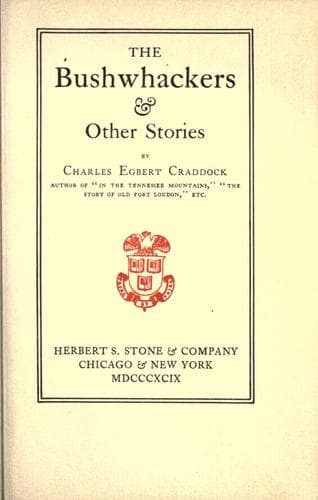
The bushwhackers & other storiesCraddock, Charles Egbert
General
The bushwhackers & other stories
Craddock, Charles Egbert
Mountain life -- Fiction; Tennessee -- Social life and customs -- Fiction
For despite the solemn stillness that brooded in the similitude of the
deepest peace upon the scene, war was still rife in the land. The
theater of action was far from this sequestered region, but there had
been times when the piny gorges were full of the more prickly growth
of bayonets. The echoing crags were taught the thrilling eloquence
of the bugle, and the mountains reverberated with the oratory of the
cannon--for the artillery learned to climb the deer-paths. There was
a fine panorama once in the twilight when a battery on the heights
shelled the woods in the valley, and tiny white clouds with hearts of
darting fire described swift aerial curves, the fuses burning brightly
against the bland blue sky, ere that supreme moment of explosion when
the bursting fragments hurtled wildly through the air.
Occasionally a cluster of white tents would spring up like mushrooms
at the base of a mountain spur--gone as suddenly as they had come,
leaving a bed of embers where the camp-fires had been, a vague wreath
of smoke and little trace besides, for the felled trees cut for fuel
made scant impression upon the densities of the wilderness, and the
rocks were immutable.
And then for months a primeval silence and loneliness might enfold the
mountains.
“Ef they kem agin, ef ever they kem agin, I’ll jine ’em--I’ll jine
’em,” cried Hilary out of a full heart as he stood and gazed.
And this was the reason he watched daily and sometimes deep into the
night, lest coming under cover of the darkness they might depart before
the dawn, leaving only the embers of their camp-fires to tell of their
vanished presence.
The prospect stirred the boy’s heart. He longed to be in the midst
of action, to take a man’s part in the great struggle, to live the
life and do the faithful devoir of a soldier. He was young but he was
strong, and he felt that here he was biding at home as if he were
no more fit for the military duty he yearned to assume than was the
miller’s daughter, Delia Noakes.
“I tole Dely yesterday ez I’d git her ter l’arn me ter spin ef ye kep’
me hyar much longer,” he said one day petulantly to his mother. “I’ll
jes’ set an’ spin like a sure-enough gal ef ye won’t let me go an’ jine
the army like a boy.”
Public-domain text, read in full here on John Shaqi.
Reviews
Reviews
No reviews yet
Be the first to share your thoughts on this work.
Join the Discussion
Join the discussion
Sign in to leave a comment or review.
Sign InorCreate an account