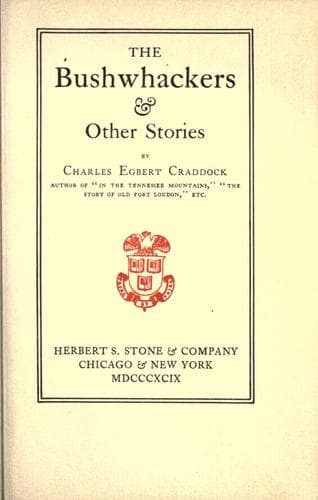
The bushwhackers & other storiesCraddock, Charles Egbert
General
The bushwhackers & other stories
Craddock, Charles Egbert
Mountain life -- Fiction; Tennessee -- Social life and customs -- Fiction
“Thar’s somebody ahint the door ez hev seen me a-comin’ an’ air waitin’
ter ketch me ‘Chris’mus Gift,’” he argued, astutely.
To forestall this he took a devious path through the brush, sprang
suddenly upon the porch, thrust in his arm, and clutched the unwary
party ambushed behind the door.
“Chris’mus Gift!” he shouted, as he burst into the room.
But it was Delia waiting for him, blushing and embarrassed, and seeming
nearer tears than laughter. And his mother was chuckling in enjoyment
of the situation.
“Now, whyn’t ye let Dely ketch you-uns Chris’mus Gift like she counted
on doin’, stiddier ketchin’ her? She hain’t got nuthin’ ter gin yer fur
Chris’mus Gift but herself.”
Hilary knew her presence here and the enterprise of “catching him
Christmas Gift” was another overture at reconciliation, but when he
said, “Waal, I’ll thank ye kindly, Dely,” she still looked at him in
silence, with a timorous eye and a quivering lip.
“But, law!” exclaimed Mrs. Knox, still laughing, “I needn’t set my
heart on dancin’ at the weddin’. Dely ain’t no ways ter be trusted. She
hev done like a Injun-giver afore now. Mebbe she’ll take herself away
from ye agin.”
Delia found her voice abruptly.
“No--I won’t, nuther!” she said, sturdily.
And thus it was settled.
They made what Christmas cheer they could, and he told them of a new
plan as they sat together round the fire. The women humored it as a
sick fancy. They never thought to see it proved. At the school held at
irregular intervals before the war he had picked up a little reading
and a smattering of writing. This Christmas day he began anew. He
manufactured ink of logwood that had been saved for dyeing, and the
goose lent him a quill. An old blank book, thrown aside when the hotel
proprietors had removed their valuables, served as paper.
As his mother had said it was not Hilary’s nature to be thankful for
the half of anything; he attacked the unpromising future with that
undismayed ardor that had distinguished him in those cavalry charges
in which he had loved to ride. With practice his left hand became
deft; before the war was over he was a fair scribe, and he often
pridefully remarked that he couldn’t be flanked on spelling. Removing
to one of the valley towns, seeking a sphere of wider usefulness, his
mental qualities and sterling character made themselves known and his
vocation gradually became assured. He was first elected register of the
county of his new home, and later clerk of the circuit court. Other
preferments came to him, and the world went well with him. It became
broader to his view and of more gracious aspect; his leisure permitted
reading and reading fostered thought. He learned that there are more
potent influences than force, and he recognized as the germ of these
benignities that impulse of peace and good will which he consecrated
for the sake of One who became as a Little Child.
THE PANTHER
OF
JOLTON’S RIDGE
CHAPTER I
Public-domain text, read in full here on John Shaqi.
Reviews
Reviews
No reviews yet
Be the first to share your thoughts on this work.
Join the Discussion
Join the discussion
Sign in to leave a comment or review.
Sign InorCreate an account