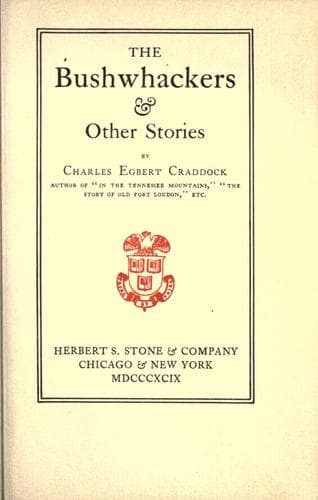
The bushwhackers & other storiesCraddock, Charles Egbert
General
The bushwhackers & other stories
Craddock, Charles Egbert
Mountain life -- Fiction; Tennessee -- Social life and customs -- Fiction
This thrust was neither parried nor returned. Joel Ruggles, discreetly
silent, gazed with a preoccupied air at the swift stream flowing far
below, beginning to darken with the overhanging shadows of the western
crags. And Mark still leaned his chin meditatively on his hands, and
his hands on the muzzle of his rifle, in an attitude so careless that
an unaccustomed observer might have been afraid of seeing the piece
discharged and the picturesque head blown to atoms.
Through the futility of much remonstrance his mother had lost her
patience--no great loss, it might seem, for in her mildest days she
had never been meek. Poverty and age, and in addition her anxiety
concerning a son now grown to manhood, good and kind in disposition,
but whose very amiability rendered him so lax in his judgment of the
faults of others as to slacken the tension of his judgment of his own
faults, and whose stancher characteristics were manifested only in
an adamantine obstinacy to her persuasion--all were ill-calculated
to improve her temper and render her optimistic, and she had had no
training in the wider ways of life to cultivate tact and knowledge of
character and methods of influencing it. Doubtless the “skimpy saint”
in the enlightenment of his vocation would have approached the subject
of these remonstrances in a far different spirit, for Mark was plastic
to good suggestions, easily swayed, and had no real harm in him. He
understood, too, the merit and grace of consistency, of being all of
a piece with his true identity, with his real character, with the
sterling values he most appreciated. But the quality that rendered
him so susceptible to good influences--his adaptability--exposed him
equally to adverse temptation. He had spoken truly when he had said
that it was only the interest of the talk of the moonshiners and their
friends--stories of hunting fierce animals in the mountain fastnesses,
details of bloody feuds between neighboring families fought out through
many years with varying vicissitudes, and old-time traditions of the
vanished Indian, once the master of all the forests and rocks and
rivers of these ancient wilds--and not the drinking of whisky, that
allured him; far less the painful and often disgusting exhibitions of
drunkenness he occasionally witnessed at the still, in which those
sufficiently sober found a source of stupid mirth. Afterward it seemed
to him strange to reflect on his course. True he had had but a scanty
experience of life and the world, and the parson’s reading from the
Holy Scriptures was his only acquaintance with what might be termed
literature or learning in any form. But arguing merely from what he
knew he risked much. From the pages of the Bible he had learned what
the leprosy was, and what, he asked himself in later years, would he
have thought of the mental balance of a man who frequented the society
of a leper for the sake of transitory entertainment or mirth to be
Public-domain text, read in full here on John Shaqi.
Reviews
Reviews
No reviews yet
Be the first to share your thoughts on this work.
Join the Discussion
Join the discussion
Sign in to leave a comment or review.
Sign InorCreate an account