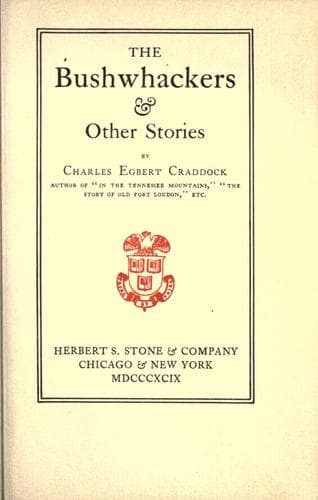
The bushwhackers & other storiesCraddock, Charles Egbert
General
The bushwhackers & other stories
Craddock, Charles Egbert
Mountain life -- Fiction; Tennessee -- Social life and customs -- Fiction
Far away in a dim recess of the deep woods, on the summit of the ridge,
amidst crags and chasms and almost inaccessible steeps, the shadows
had gathered about a dismal little log hut of one room--like all the
other dismal little hovels of the mountain, save that in front of the
door the grass was worn away from a wide space by the frequent tread
of many feet; a preternaturally large wood-pile was visible under a
frail shelter in the rear of the house; from the chimney a dense smoke
rose in a heavy column; and the winds that rushed past it carried on
their breath an alcoholic aroma. But for these points of dissimilarity
and its peculiarly secluded situation, Mark Yates, dismounting from
his restive steed, might have been entering his mother’s dwelling. The
opening door shed no glare of firelight out into the deepening gloom
of the dusk. It was very warm within, however--almost too warm for
comfort; but the shutters of the glassless window were tightly barred,
and the usual chinks of log-house architecture were effectually closed
with clay. The darkness of the room was accented rather than dispelled
by a flickering tallow dip stuck in an empty bottle in default of a
candlestick, and there was an all-pervading and potent odor of spirits.
The salient feature of the scene was a stone furnace, from the closed
door of which there flashed now and then a slender thread of brilliant
light. A great copper still rose from it, and a protruding spiral tube
gracefully meandered away in the darkness through the cool waters of
the refrigerator to the receiver of its precious condensed vapors.
There were four jeans-clad mountaineers seated in the gloomy twilight
of this apartment; and the stories of “bar-huntin’ an’ sech” must have
been very jewels of discourse to prove so alluring, as they could
certainly derive no brilliancy from their unique but somber setting.
“Hy’re, Mark! Come in, come in,” was the hospitable insistence which
greeted young Yates.
“Hev a cheer,” said Aaron Brice, the eldest of the party, bringing out
from the darkness a chair and placing it in the feeble twinkle of the
tallow dip.
“Take a drink, Mark,” said another of the men, producing a broken-nosed
pitcher of ardent liquor. But notwithstanding this effusive
hospitality, which was very usual at the still-house, Mark Yates
had an uncomfortable impression that he had interrupted an important
conference, and that his visit was badly timed. The conversation that
ensued was labored, and hosts and guest were a trifle ill at ease.
Frequent pauses occurred, broken only by the sound of the furnace fire,
the boiling and bubbling within the still, the gurgle of the water
through its trough, that led it down from a spring on the hill behind
the house to the refrigerator, the constant dripping of the “doublings”
from the worm into the keg below. Now and then one of the brothers
hummed a catch which ran thus:--
Public-domain text, read in full here on John Shaqi.
Reviews
Reviews
No reviews yet
Be the first to share your thoughts on this work.
Join the Discussion
Join the discussion
Sign in to leave a comment or review.
Sign InorCreate an account