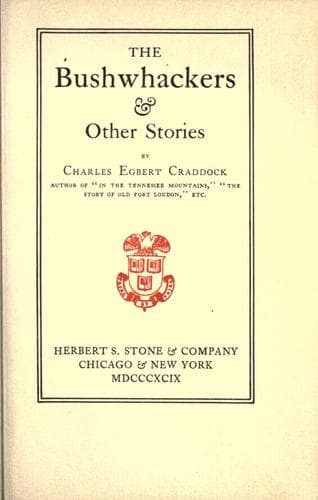
The bushwhackers & other storiesCraddock, Charles Egbert
General
The bushwhackers & other stories
Craddock, Charles Egbert
Mountain life -- Fiction; Tennessee -- Social life and customs -- Fiction
Thus adjured the intruder closed the door, placed the jug on the floor,
and looked about with an embarrassed hesitation of manner. The flare
from the furnace, which Aaron Brice had opened to pile in fresh wood,
illumined the newcomer’s face and long, loose-jointed figure and showed
the semicircle of mountaineers seated in their rush-bottomed chairs
about the still. None of them spoke. Never before since the still-house
was built had a visitor stood upon the puncheon floor that one of the
hospitable Brices did not scuttle for a chair, that the dip was not
eagerly snuffed in the vain hope of irradiating the guest, that the
genial though mutilated pitcher filled with whisky was not ungrudgingly
presented. No chair was offered now, and the broken-nosed pitcher with
its ardent contents was motionless on the head of a barrel. It was a
strange change, and as the broad red glare fell on their stolid faces
and blankly inexpressive attitudes the guest looked from one to the
other with an increasing surprise and a rising dismay. The light was
full for a moment upon Mark Yates’s shock of yellow hair, gray eyes,
and muscular, well-knit figure, as he, too, sat mute among his hosts.
He was not to be mistaken, and once seen was not easily forgotten.
The next instant the furnace door clashed, and the room fell back
into its habitual gloom. One might note only the gurgle of the spring
water--telling of the wonders of the rock-barricaded earth below and
the reflected glories of the sky above--only the hilarious song of
the still, the continuous trickle from the worm, the all-pervading
spirituous odors, and the shadowy outlines of the massive figures of
the mountaineers.
The Brices evidently could not be relied upon to break the awkward
silence. The newcomer, mustering heart of grace, took up his testimony
in a languid nasal drawl, trying to speak and to appear as if he had
noticed nothing remarkable in his reception.
“I hev come, Aaron,” he said, “ter git another two gallons o’ that thar
whisky ez I hed from you-uns, an’ I hev brung the balance of the money
I owed ye on that, an’ enough ter pay for the jugful, too. Hyar is a
haffen dollar fur the old score, an’--”
“That thar eends it,” said Aaron, pocketing the tendered fifty cents.
“We air even, an’ ye’ll git no more whisky from hyar, Mose Carter.”
“Wha--what did ye say, Aaron? I hain’t got the rights ’zactly o’ what
ye said.” And Carter peered in great amaze through the gloom at his
host, who was carefully filling a pipe. As Aaron stooped to get a coal
from the furnace one of the others spoke.
“He said ez ye’ll git no more whisky from hyar. An’ it air a true
word.”
The flare from the furnace again momentarily illumined the room, and as
the door clashed it again fell back into the uncertain shadow.
Public-domain text, read in full here on John Shaqi.
Reviews
Reviews
No reviews yet
Be the first to share your thoughts on this work.
Join the Discussion
Join the discussion
Sign in to leave a comment or review.
Sign InorCreate an account