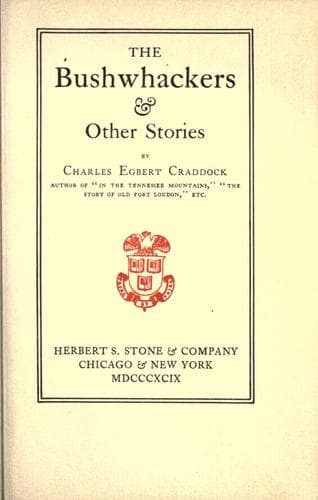
The bushwhackers & other storiesCraddock, Charles Egbert
General
The bushwhackers & other stories
Craddock, Charles Egbert
Mountain life -- Fiction; Tennessee -- Social life and customs -- Fiction
“I ain’t small-sized an’ spindling now,” said Hilary, drawing himself
up to his full height and bridling with offended dignity in the
consciousness of his inches and his muscles. “I know ez Cap’n Baker or
enny other officer would ’list me now, for though I ain’t quite sixteen
I be powerful well growed fur my age.”
As he realized this anew his flush deepened as he stood and looked
down at the fire, while his mother covertly watched his expression. He
felt it a burning shame that he should still linger here laggard when
all his instinct was to help and sustain the cause of his countrymen.
His loyalty was to the sense of home. His impulse was to repel the
invader, although the majority of the mountaineers of East Tennessee
were for the Union, and many fought for the old flag against their
neighbors and often against their close kindred, so stanch was their
loyalty in those times that tried men’s souls.
One day, as Hilary, straining his eyes, stood on his perch on the crag,
he beheld fluttering far, far away--was it a wreath of mist floating
along the level, sinuous curves of the distant valley road--a wreath of
mist astir on some gentle current of the atmosphere? He had a sudden
sense of color. Did the vapor catch a prismatic glister from the sun’s
rays? And now faint, far, like the ethereal tones of an elfin horn,
a mellow vibration sounded on the air. Hardly louder it was than the
booming of a bee in the heart of a flower, scarcely more definite
than the melody one hears in a dream, which one can remember, yet
cannot recognize or sing again; nevertheless his heart bounded at the
vague and vagrant strain, and he knew the fluttering prismatic bits of
color to be the guidons of a squadron of cavalry. His heart kept pace
with the hoofbeats of the horses. The lessening distance magnified
them to his vision till he could discern now a bright glint of steely
light as the sun struck on the burnished arms of the riders, and
could distinguish the tints of the steeds--gray, blood-bay, black and
roan-red; he could soon hear, too, the jingle of the spurs, the clank
of sabers and carbines, and now and again the voices of the men, bluff,
merry, hearty, as they rode at their ease. He would not lose sight of
them till they had paused to pitch their camp at the foot of a great
spur of the mountain opposite. There was a famous spring of clear,
cold water there, he remembered.
Public-domain text, read in full here on John Shaqi.
Reviews
Reviews
No reviews yet
Be the first to share your thoughts on this work.
Join the Discussion
Join the discussion
Sign in to leave a comment or review.
Sign InorCreate an account