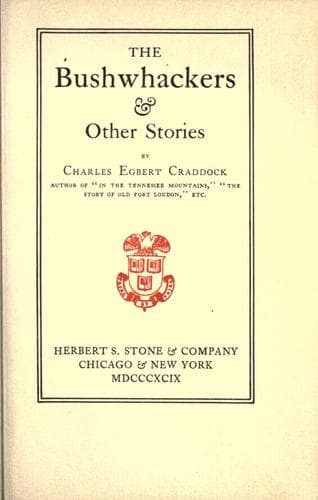
The bushwhackers & other storiesCraddock, Charles Egbert
General
The bushwhackers & other stories
Craddock, Charles Egbert
Mountain life -- Fiction; Tennessee -- Social life and customs -- Fiction
The four brothers glanced at one another with hot, wild eyes. They had
reason to suspect that they were themselves the subject of the parson’s
supplications, and they resented this as a liberty. They had prized
their standing in the church not because they were religious, in the
proper sense of the word, but from a realization of its social value.
In these primitive regions the sustaining of a reputation for special
piety is a sort of social distinction and a guarantee of a certain
position. The moonshiners neither knew nor cared what true religion
might be. To obey its precepts or to inconvenience themselves with
its restraints, was alike far from their intention. They had received
with boundless amazement the first intimation that the personal and
practical religion which the “skimpy saint” had brought into the
gorge might consistently interfere with the liquor trade, the illicit
distilling of whisky, and the unlimited imbibing thereof by themselves
and the sottish company that frequented the still-house. They had
laughed at his temperance sermons and ridiculing his warnings had
treated the whole onslaught as a trifle, a matter of polemical theory,
in the nature of things transitory, and had expected it to wear out as
similar spasms of righteousness often do--more’s the pity! Then they
would settle down to continue to furnish spirituous comfort to the
congregation, while the “skimpy saint” ministered to their spiritual
needs. The warlike little parson, however, had steadily advanced his
parallels, and from time to time had driven the distillers from one
subterfuge to another, till at last, although they were well off in
this world’s goods--rich men, according to the appraisement of the
gorge--they were literally turned out of the church, and had become
a public example, and they felt that they had experienced the most
unexpected and disastrous catastrophe possible in nature.
They were stunned that so small a man had done this thing, a man, so
poor, so weak, so dependent for his bread, his position, his every
worldly need, on the favor of the influential members of his scattered
congregations. It had placed them in their true position before their
compeers. It had reduced their bluster and boastfulness. It had made
them seem very small to themselves, and still smaller, they feared, in
the estimation of others.
Moses Carter--himself no shining light, indeed a very feebly glimmering
luminary in the congregation--looked from one to the other of their
aghast indignant faces with a ready relish of the situation, and said,
with a grin:
“I reckon, Painter, ef the truth war plain, ye’d ruther hev all the
gorge ter know ez the pa’son war a-spreadin’ the fac’s about this hyar
still afore a United States marshal than afore the throne o’ grace,
like he be a-doin’ of right now.”
Public-domain text, read in full here on John Shaqi.
Reviews
Reviews
No reviews yet
Be the first to share your thoughts on this work.
Join the Discussion
Join the discussion
Sign in to leave a comment or review.
Sign InorCreate an account