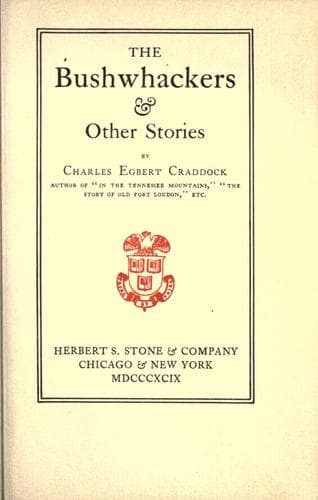
The bushwhackers & other storiesCraddock, Charles Egbert
General
The bushwhackers & other stories
Craddock, Charles Egbert
Mountain life -- Fiction; Tennessee -- Social life and customs -- Fiction
There had never before been a church building in this vicinity; “summer
preachin’” under the forest oaks had sufficed, with sometimes at long
intervals a funeral sermon at the house of a neighbor. But in response
to that strenuous cry, “Be up and doing,” and in acquiescence with
the sharp admonition that religion does not consist in singing sleepy
hymns in a comfortable chimney-corner, the whole countryside had
roused itself to the privilege of the work nearest its hand. Practical
Christianity first developed at the saw-mill. The great logs, seasoned
lumber from the forest, were offered as a sacrifice to the glory of
God, and as the word went around, Mark Yates, always alert, was among
the first of the groups that came and stood and watched the gleaming
steel striking into the fine white fibers of the wood--the beginnings
of the “church-house”--while the dark, clear water reflected the great
beams and roof of the mill, and the sibilant whizzing of the simple
machinery seemed, with the knowledge of the consecrated nature of its
work, an harmonious undertone to the hymning of the pines, and the
gladsome rushing of the winds, and the subdued ecstasies of all the
lapsing currents of the stream.
Mark had looked on drearily. His spirit, awakened by the clarion call
of duty, fretted and revolted at the restraints of his lack of means.
He could do naught. It was the privilege of others to prepare the
lumber. It seemed that even inanimate nature had its share in building
the church--the earth in its rich nurture that had given strength to
the great trees; the seasons that had filled the veins of each with the
rich wine of the sap, the bourgeoning impulse of its leafage and the
ripeness of its fine fruitions; the rainfall and sunshine that had fed
and fostered and cherished it--only he had naught to give but the idle
gaze of wistful eyes.
The miller, a taciturn man, was very well aware that he had sawed
the lumber. He said naught when the work was ended, but surveyed the
great fragrant piles of cedar and walnut and maple and cherry and oak,
the building woods of these richly endowed mountains, with a silence
so significant that it spoke louder than words. It said that his work
was finished, and who was there who would do as much or more? So loud,
so forceful, so eloquent was this challenge that the next day several
teamsters came and stood dismally each holding his chin-whiskers in his
hand and contemplated the field of practical Christianity.
“It’ll be a powerful job ter hev ter haul all that thar lumber, sure!”
said one reluctant wight, in disconsolate survey, his mouth slightly
ajar, his hand ruefully rubbing his cheek.
“It war a powerful job ter saw it,” said the miller.
Public-domain text, read in full here on John Shaqi.
Reviews
Reviews
No reviews yet
Be the first to share your thoughts on this work.
Join the Discussion
Join the discussion
Sign in to leave a comment or review.
Sign InorCreate an account