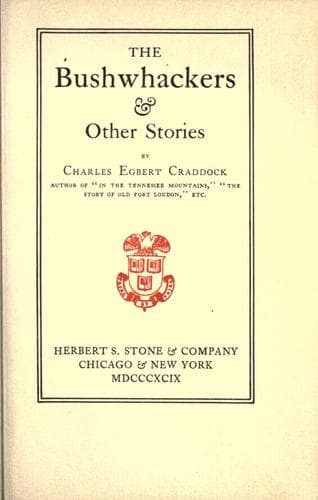
The bushwhackers & other storiesCraddock, Charles Egbert
General
The bushwhackers & other stories
Craddock, Charles Egbert
Mountain life -- Fiction; Tennessee -- Social life and customs -- Fiction
None of them realized how much of the work Mark had done. Each
looked only at the result, knowing it to be the aggregated industry
and leisure of the neighbors, laboring as best they might and as
opportunity offered. This was no hindrance to Mark’s satisfaction. He
had wanted to help, not to make a parade of his help, or to have what
he had done appreciated. He thought the little preacher, the “skimpy
saint,” as his unfriends called him, had a definite idea of what he had
done. In the stress of this man’s lofty ideals he could compromise with
little that failed to reach them. He was forever stretching onward and
upward. But Mark noted a kindling in his intent eye one day, while “the
chinking” was being put in, the small diagonal slats between the logs
of the wall on which the clay of the “daubing” was to be plastered.
“Did you do all this side?” he had asked.
As Mark answered “Yes,” he felt his heart swell with responsive pride
to win even this infrequent look of approval, and he went on to claim
more. “Don’t tell nobody,” he said, glancing up from his kneeling
posture by the side of the wall. “But I done that corner, too, over
thar by the door. Old Joel Ruggles done it fust, but the old man’s
eyesight’s dim, an’ his hand onstiddy, an’ ’twar all crooked an’
onreg’lar, so _unbeknown_ ter _him_ I kem hyar early one day an’ did
it over,--though he don’t know it,--so ez ’twould be ekal--all of a
piece.”
The “skimpy saint” now hardly seemed to care to glance at the work. He
still stood with his hand on the boy’s shoulder, looking down at him
with eyes in which Mark perceived new meanings.
“You can sense, then, the worth of hevin’ all things of a piece with
the best. See ter it, Mark, that ye keep yer life all of a piece with
this good work--with the best that’s in ye.”
So Mark understood. But nowadays he hardly felt all of a piece with
the good work he had done on the church walls, against so many
discouragements, laboring early and late, seeking earnestly some means
that might be within his limited power. Oftentimes, after the church
was finished, he went and stood and gazed at it, realizing its stanch
validity, without shortcomings, without distortions--all substantial
and regular, with none of the discrepancies and inadequacies of his
moral structure.
While silently and meditatively recalling all these facts as he sat
this night of early spring among the widely unrelated surroundings
of the still, the shadowy group of moonshiners about him, Mark Yates
looked hard at Panther Brice’s sharp features, showing, in the thread
of white light from the closed door of the furnace, with startling
distinctness against the darkness, like some curiously carved cameo. He
never understood the rush of feeling that constrained him to speak, and
afterward, when he thought of it, his temerity surprised him.
Public-domain text, read in full here on John Shaqi.
Reviews
Reviews
No reviews yet
Be the first to share your thoughts on this work.
Join the Discussion
Join the discussion
Sign in to leave a comment or review.
Sign InorCreate an account