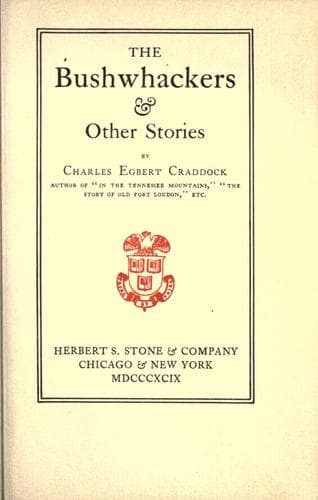
The bushwhackers & other storiesCraddock, Charles Egbert
General
The bushwhackers & other stories
Craddock, Charles Egbert
Mountain life -- Fiction; Tennessee -- Social life and customs -- Fiction
The freedom of Oop-pa’s tongue was resented as evidently by Choolah
as by Ronald, but the _Etissu_ occupied a semi-sacerdotal position
toward the chief, a war-captain, the decrees of whose religion would
not suffer him to touch a morsel of food or a drop of drink while
on the war-path unless administered by the _Etissu_. The utmost
abstemiousness was preserved among the Chickasaws throughout, and it
continued a marvel to the British troops how men could march or fight
so ill-nourished, practicing all the fasting austerities of religious
observances. There were many similar customs implying consecration to
war as holy duty, but they were gradually becoming modified by the
introduction of foreign influences, for formerly the Indians would
not have suffered among them on the march the unsanctified presence
of a stranger like Ronald MacDonnell. He said naught in reply to the
_Etissu_. His mind was grimly preoccupied. He was busied with the
realization of how strong he was, how very strong. These lithe Indians,
with all their supple elasticity, their activity, had no such staying
power as he, no such muscular vitality. He was thinking what resources
of anguish his stalwart physique offered for the hideous sport of the
torture; how his stanch flesh would resist. How long, how long dying he
would be!
The terrors of capture by the Cherokees had been by Grant’s orders
described again and again to the troops to keep the rank and file
constant to duty, close in camp, vigilant on outpost, and alert to
respond to the call to arms. Never, as Ronald righteously repeated
this grim detail, had he imagined he would ever be in case to remember
it with a personal application. He now protested inwardly that he
could die like a soldier. Even from the extremity of physical anguish
he had never shrunk. But the hideous prospect of the malice of human
fiends wreaked for hours and hours upon every quivering nerve, upon
every sensitive fiber, with the wonderful ingenuity for which the
Cherokees were famous, made him secretly wince as he crouched there
among the friendly Chickasaws, beneath the boughs of the rhododendron
splendidly a-bloom in the moonlight, while the rich, pearly glamours
of the broken disk sunk down and down the sky, and the dew glimmered
on the full-fleshed leaves, and through them a silver glitter from
the Tennessee River hard by struck his eye, and a break in the woods,
where the channel curved, showed the contour of a dome of the Great
Smoky Mountains limiting the instarred heavens. As he looked out from
the covert of the laurel--his flaxen hair visible here and there in
rings on his sunburned forehead, from which his blue bonnet was pushed
back; his strongly marked high features, hardly so immobile as was
their wont; his belt, his plaid, his claymore, all the details of that
ancient martial garb, readjusted with military precision since the
fight; his long, rawboned figure, lean and muscular, but nevertheless
Public-domain text, read in full here on John Shaqi.
Reviews
Reviews
No reviews yet
Be the first to share your thoughts on this work.
Elsewhere in the archive
Join the Discussion
Join the discussion
Sign in to leave a comment or review.
Sign InorCreate an account