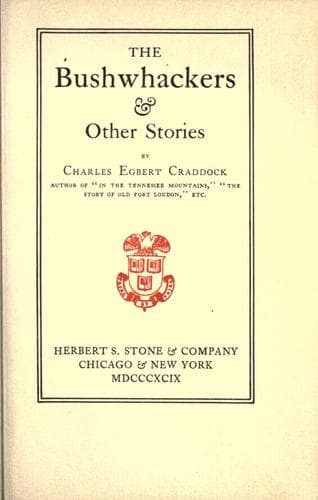
The bushwhackers & other storiesCraddock, Charles Egbert
General
The bushwhackers & other stories
Craddock, Charles Egbert
Mountain life -- Fiction; Tennessee -- Social life and customs -- Fiction
with a suggestion of the roundness of youth, half reclining, supported
on one arm--the Indian gazed at him with questioning intentness.
Suddenly Choolah spoke.
“_Angona_,” (friend) he said, with a poignant note of distrust, “you
have a thought in your mind.”
It was seldom indeed, that Ronald MacDonnell could have been thus
accused. He changed color a trifle, although he said, hastily, “Oh, no,
my good man, not at all--not at all!”
“_Angona! Angona!_” cried Choolah, in reproach.
Perhaps a definite recognition of this thought in his mind came to
MacDonnell with the fear that the Chickasaw, who so easily discerned
it, would presently read it. “The fearsome Fox that he is,” thought
Ronald with an almost superstitious thrill at his heart.
Naturally he could not know how open was that frank face of his,
and that the keen discernment of the savage, though perceiving the
presence of the withheld thought, was yet inadequate to translate
its meaning. This thought was one which he would in no wise share
with Choolah. MacDonnell’s most coherent mental process was always
of a military trend; without a definite effort of discrimination, or
even voluntarily reverting to the events of the day, it had suddenly
occurred to him that the Cherokee with the essential improvidence of
the Indian nature, could not have developed that plan of attack on the
provision train, so determined and definitely designed, so difficult
to repulse, so repeated, renewed again and again with a desperation of
the extremest sacrifice to the end. And small wonder! Its success would
have involved the practical destruction of Grant’s whole army. Hundreds
of miles distant from any sufficient base of supplies, the provision
train was the life of the expedition. The beef-herds to be subsequently
driven out from the province to Fort Prince George for the use of
the army were to be timed with a view to the gradual consumption of
the provisions already furnished, and to communicate by messenger to
Charlestown, now distant nearly four hundred miles, the disaster of the
capture of stores would obviously involve a delay fatal to the troops.
Public-domain text, read in full here on John Shaqi.
Reviews
Reviews
No reviews yet
Be the first to share your thoughts on this work.
Elsewhere in the archive
Join the Discussion
Join the discussion
Sign in to leave a comment or review.
Sign InorCreate an account