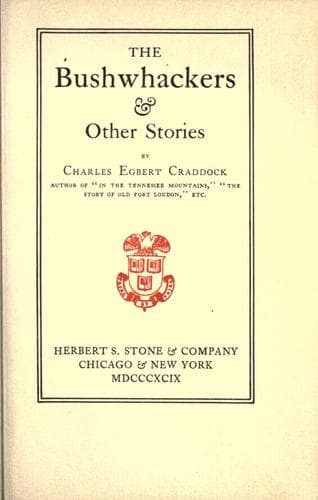
The bushwhackers & other storiesCraddock, Charles Egbert
General
The bushwhackers & other stories
Craddock, Charles Egbert
Mountain life -- Fiction; Tennessee -- Social life and customs -- Fiction
They were hardly out of sight when MacDonnell, kicking the enveloping
blanket out of the way, sat down on one of the logs by the fire and
spread his big bony hands out to the blaze. It was growing chill;
the June night was wearing on toward the dawn; it was that hour of
reduced vitality when hope seems of least value, and the blood runs
low, and conscience grows keen, and the future and the past bear
heavily alike on the present. The prisoner was shivering slightly.
He glanced expectantly at the Scotchman’s impassive countenance. No
man knew better than Ronald MacDonnell the churlishness of a lack of
consideration of the comfort of others in small matters. No man could
offer little attentions more genially. They comported essentially with
his evident breeding, and his rank in the army; once more the prisoner
looked expectantly at him, and then, wounded, like a Frenchman, as
for a host’s lack of consideration, he sat down on a log uninvited,
casting but one absent glance, from which curiosity seemed expunged,
at the effigies which explained how the Cherokees came to their fate.
It mattered little now, his emotional, sensitive face said. Naught
mattered! Naught! Naught!
In the sudden nervous shock his vitality was at its lowest ebb. He
could not spread his hands to the blaze, for his arms had been pinioned
cruelly tight. He shivered again, for the fire was low. MacDonnell
noticed it, but he did not stir; perhaps he thought Johnny Crapaud
would soon find the fire hot enough. The scout himself mended it, as
he sat tailorwise on the ground between the other two men. Now and
again the _Etissu_ gazed at MacDonnell’s impassive, rather lowering
countenance, with a certain awe; if he had expected the officer to show
the squeamishness which Colonel Grant developed in such matters, or any
pity, he was mistaken; then he looked with curiosity at the Frenchman.
The prisoner’s lips were vaguely moving, and Ronald MacDonnell
caught a suggestion of the sound--half-whispered words, not French,
or he would not have understood; Latin!--paters and aves! As he had
expected--frogs, papistry, French, and fool!
“What’s that?” the Highland officer said, so suddenly that the scout
started in affright.
“Nothing,” said the Indian; “the wind, perhaps.”
“Sticks cracking in the laurel--a bear, perhaps,” suggested MacDonnell,
taking up a loaded musket and laying it across his knee. Then “Only a
bear,” he repeated reassuringly.
“Choolah ought to leave more men here,” said the _Etissu_.
“It’s nothing!” declared MacDonnell, rising and looking warily about.
“Perhaps Choolah on his way back.”
Public-domain text, read in full here on John Shaqi.
Reviews
Reviews
No reviews yet
Be the first to share your thoughts on this work.
Elsewhere in the archive
Join the Discussion
Join the discussion
Sign in to leave a comment or review.
Sign InorCreate an account