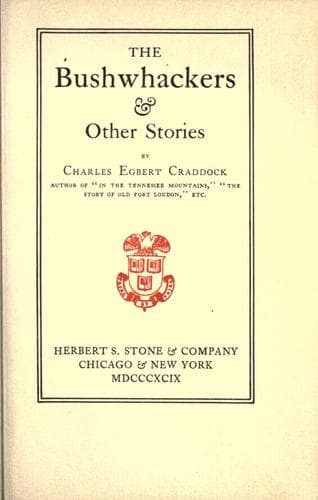
The bushwhackers & other storiesCraddock, Charles Egbert
General
The bushwhackers & other stories
Craddock, Charles Egbert
Mountain life -- Fiction; Tennessee -- Social life and customs -- Fiction
The scout was true to his vagrant tendencies, or perhaps because of
those tendencies he felt himself safer in the dense, impenetrable
jungle, crawling along flat like a lizard or a snake, than seated
perched up here on a bluff by a flaring camp-fire with only two other
men, a mark for “Brown Bess”--the Cherokees were all armed with British
muskets, although they were in revolt, and perhaps it was one reason
why they were in revolt--for many a yard up and down the Tennessee
River. “I go see,” he suggested.
“No, no,” said MacDonnell, “only a bear.”
“I come back soon,” declared the _Etissu_, half crouching and gazing
about, “soon, soon. _Alooska, Ko-e-u-que-ho._” (I do not lie, I do not
indeed.)
MacDonnell lifted his head and gazed about with a frowning mien of
reluctance “_Maia cha!_” (Go along) he said at last. Then called out,
“Come back _soon_,” as his attention returned to the priming and
loading of a pistol which he had in progress. “Soon! remember!”
The scout was off like a rabbit. For a moment or two MacDonnell did not
lift his eyes, while they heard him crashing through the thicket. Then
as he looked up he met the dull despair in the face of the bound and
helpless Frenchman. It mattered little to him who came, who went. He
gasped suddenly in amazement. The Highland officer was gazing at him
with a genial, boyish smile, reassuring, almost tender.
“Run, now, run for your life!” he said, leaning forward, and with a
pass or two of a knife he severed the prisoner’s bonds.
In the revulsion of feeling the man seemed scarcely able to rise to
his feet. There were tears in his eyes; his face quivered as he looked
at his deliverer.
“Danger--big fire--burn,” said the astute MacDonnell, as if the English
words thus detached were more comprehensible to the French limitations.
Perhaps his gestures aided their effect, and as he held out his hand
in his whole-souled, genial way, the Frenchman grasped it in a hard
grip of fervent gratitude and started off swiftly. The next moment the
young officer turned back, caught the British soldier in his arms, and
to MacDonnell’s everlasting consternation kissed him in the foreign
fashion, first on one cheek and then on the other.
Ronald MacDonnell’s mess often preyed upon the disclosures which his
open, ingenuous nature afforded them. But his simplicity stopped far
short of revealing to them this Gallic demonstration of gratitude--so
exquisitely ludicrous it seemed to his unemotional methods and mind.
They were debarred the pleasure of racking him on this circumstance.
They never knew it. He disclosed it only years afterward, and then by
accident, to a member of his own family.
Public-domain text, read in full here on John Shaqi.
Reviews
Reviews
No reviews yet
Be the first to share your thoughts on this work.
Elsewhere in the archive
Join the Discussion
Join the discussion
Sign in to leave a comment or review.
Sign InorCreate an account