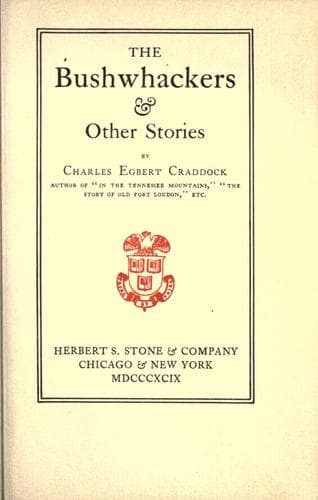
The bushwhackers & other storiesCraddock, Charles Egbert
General
The bushwhackers & other stories
Craddock, Charles Egbert
Mountain life -- Fiction; Tennessee -- Social life and customs -- Fiction
And Ronald MacDonnell answered that he had granted to his prisoner
exactly what he had intended to demand of his captor had the situation
been reversed--to adjure him by their fellow feeling as soldiers, by
the customs of civilized warfare, by the bond of a common religion, to
save him from torture by savages.
“Can a gentleman give less than he would ask?” he demanded.
And when Colonel Grant would urge that he should have trusted to his
authority to protect the prisoner, Ronald would meet the argument with
the counter-argument that the Indians respected no authority, and in
cases of fire it would not do to take chances.
“Why did you not at least exact a parole?”
“Lord, sir, we couldn’t talk at all!” said Ronald, conclusively. “In
common humanity, I was obliged to release him or shoot him, and I
could not shoot an unarmed prisoner to save my life--not if I were to
be shot for it myself.”
Lieutenant-Colonel Grant’s heart was well known to be soft in spots. He
has put it upon record in the previous campaign against the Cherokees
that he could not help pitying them a little in the destruction of
their homes,--it is said, however, that after this later expedition
his name was incorporated in the Cherokee language as a synonym of
devastation and a cry of warning. He was overcome by the considerations
urged upon him by the Lieutenant until once more the possibility loomed
upon the horizon that it was Louis Latinac who had escaped him, when
he would feel that nothing but Ronald MacDonnell’s best heart’s blood
could atone for the release. To set this much vexed question at rest
the young officer was repeatedly required to describe the personal
appearance of the stranger, and thus it was that poor Ronald’s verbal
limitations were brought so conspicuously forward. “A fine man,”
he would say one day, and in giving the details of that sensitive
emotional countenance which had so engaged his interest that momentous
night--its force, its suggestiveness, its bright, alert young eyes,
would intimate that he had indeed held the motive power of the Cherokee
war in his hand, and had heedlessly loosed it as a child might release
a butterfly. The next day “a braw callant” was about the sum of his
conclusions, and Colonel Grant would be certain that the incident
represented no greater matter than the escape of a brisk subaltern,
like Ronald himself. In the course of Colonel Grant’s anxious
vacillations of opinion, the young Highlander was given to understand
that he would be instantly placed under arrest, but for the fact that
every officer of experience was urgently needed. And indeed Colonel
Grant presently had his hands quite full, fighting a furious battle
only the ensuing day with the entire Cherokee nation.
Public-domain text, read in full here on John Shaqi.
Reviews
Reviews
No reviews yet
Be the first to share your thoughts on this work.
Elsewhere in the archive
Join the Discussion
Join the discussion
Sign in to leave a comment or review.
Sign InorCreate an account