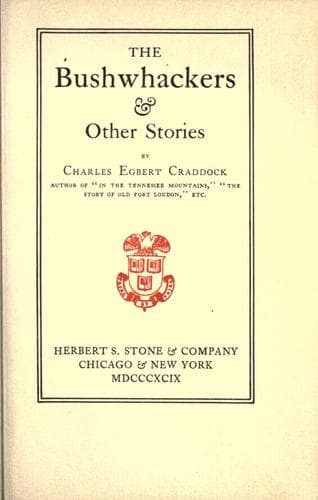
The bushwhackers & other storiesCraddock, Charles Egbert
General
The bushwhackers & other stories
Craddock, Charles Egbert
Mountain life -- Fiction; Tennessee -- Social life and customs -- Fiction
But Choolah did not thus receive it. In the simplicity of savage
life lies are admittedly the natural incidents of conversation. He
addressed himself anew to argument. At home the Tartan men lived
in mountains,--just like the Cherokees,--and no wonder they were
undismayed by the war whoops--they had heard the like before! Savages
themselves! They had a language, too, that the Carolinians could
not speak; he himself had heard it among the Highlanders of Grant’s
camp--doubtless it was the Cherokee tongue, for they were mere
Cherokees!
“_Holauba! Holauba! Feenah!_” No denial could be more definite than the
tone and the words embodied.
The wily Choolah, maliciously delighted with his power to pierce the
heart of the proud Scotchman thus, turned the knife anew. Did not the
provincials declare that the Highlanders at home were always beaten in
war, as they would be here but for the help of the Carolinians?
“_Holauba! Holauba! Feenah!_” protested Ronald resolutely, thinking of
Preston Pans and Falkirk.
For the usual emulous bickering between regulars and provincials,
which seems concomitant with every war, had appeared in full force in
this expedition, the provincials afterward claiming that but for them
and their Indian allies no remnant of the British force would have
returned alive; and the regulars declaring that the Carolinians knew
nothing, and could learn nothing of discipline and method in warfare,
laying great stress on the fact that this was the second campaign to
which the British soldiers had been summoned for the protection of
the province, which could not without them defend itself against the
Cherokees, and assuming the entire credit of the subjugation of that
warlike tribe that had for nearly a century past desolated at intervals
the Carolina borders.
Although it had been Choolah’s hope that, by means of provoking against
the Lieutenant the displeasure of his superior officer, he might
revenge himself upon MacDonnell, for snatching from the Chickasaws the
peculiar racial delight of torturing the French prisoner, the Indians
had no anticipation of the gravity of the crisis when they came to
the camp with the details of the occurrence, which, to Colonel Grant’s
annoyance, tallied with MacDonnell’s own report of himself.
For there was a question in Colonel Grant’s mind whether the prisoner
were not the redoubtable Louis Latinac, who had been so incredibly
efficient in the French interest in this region, and who had done more
to excite the enmity of the Cherokees against their quondam allies, the
British, and harass his Majesty’s troops than a regiment of other men
could accomplish. When Grant tended to this opinion, a court-martial
seemed impending over the head of the young officer.
“What was your reason for this extraordinary course?” Colonel Grant
asked.
Public-domain text, read in full here on John Shaqi.
Reviews
Reviews
No reviews yet
Be the first to share your thoughts on this work.
Elsewhere in the archive
Join the Discussion
Join the discussion
Sign in to leave a comment or review.
Sign InorCreate an account