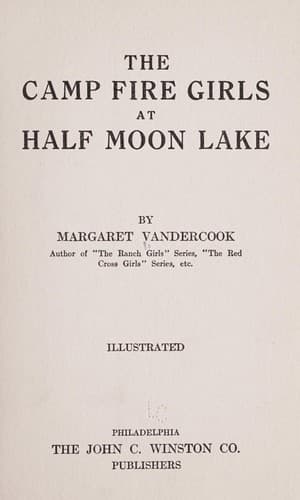
The Camp Fire Girls at Half Moon Lake — John Shaqi
The Camp Fire Girls at Half Moon LakeVandercook, Margaret
General
The Camp Fire Girls at Half Moon Lake
Vandercook, Margaret
Camp Fire Girls -- Juvenile fiction; Girls -- Societies and clubs -- Juvenile fiction
Brought up by her father on their large wheat farm in the middle west,
Mary Gilchrist had lived an outdoor life, and without a mother had been
taught few of the social amenities. During the years abroad, her
strength and endurance, her skill as a motorist, her somewhat boyish
abilities had proved so useful that it had not occurred to Mary
Gilchrist until her return to the United States that she was without the
social knowledge and education that girls of her age and position should
possess. Before her visit home, during the few weeks in New York City,
she had been conscious of her own awkwardness, particularly appreciating
the difference between her own manners and Bettina Graham’s. For this
reason, as well as others, she was pleased over the Camp Fire’s choice
of the Adirondack forest for their winter home. In a wide, free, outdoor
atmosphere she would be once more at ease and undisturbed by her want of
social knowledge.
Then, unexpectedly, Bettina’s mother, Mrs. Graham, had chosen to spend
the winter with them and from the first moment of their introduction
Gill had been able to understand why Bettina Graham had acquired a poise
and graciousness no one of the other Sunrise Camp Fire girls possessed.
Moreover, what Bettina had in slight measure her mother possessed in
fuller degree. Indeed, not alone to Mary Gilchrist’s untrained judgment,
but among persons with the widest social acquaintance, Betty Graham was
famous for her charm of manner and her gift for attracting men and
women.
“I wrote to ask you to come to see me to-day for a special reason, Mr.
Drain. But because I am sorrier than I can say I am going to explain to
you at once and have the ordeal past. I shall not ask you to forgive me,
only to appreciate my regret. Suppose we both sit down.”
Instinctively disliking Allan Drain, yet Mary Gilchrist realized that he
also had a gracious and cultivated manner when he chose to employ it, as
he did with Mrs. Graham. From her vantage point, Gill watched him draw a
chair closer to the fire and wait until Mrs. Graham was seated, before
seating himself near her.
“I cannot imagine why you should be asking my pardon for a mistake or a
fault, but of course you know that I freely forgive you. The apology
should come from me. I appreciated later that I ought not to have thrust
my poor verses upon you to bore you and absorb your time when I knew you
so slightly. The truth is I am lonely this winter and my scribbling
means more to me than it warrants. My family are not in sympathy with my
versifying or any of my views of life. There are no women among us,
there is only my father, two older brothers and myself. They have worked
very hard and are not prosperous and feel I ought to be grateful to my
uncle for offering me the education they were not able to have.”
Public-domain text, read in full here on John Shaqi.
Reviews
Reviews
No reviews yet
Be the first to share your thoughts on this work.
Join the Discussion
Join the discussion
Sign in to leave a comment or review.
Sign InorCreate an account