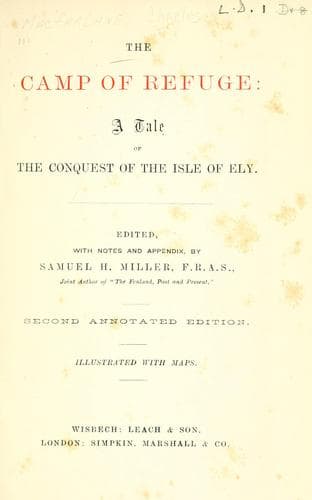
The Camp of Refuge: A Tale of the Conquest of the Isle of ElyMacFarlane, Charles
History
The Camp of Refuge: A Tale of the Conquest of the Isle of Ely
MacFarlane, Charles
Great Britain -- History -- Medieval period, 1066-1485 -- Fiction
“And I again say nay,” quoth the Lord of Brunn. “I tell ye again, that
ye shall have safe escort to the edge of the fens, and that not a hair
of your head shall be injured—provided only ye do not insult homely
honest folk by calling them foul names, or by otherwise treating them
discourteously, for if ye offend in that way the Saxon blood may boil
up and cause my orders to be forgotten. So now go!—and if I cannot say
Fare ye well for aye, I say May ye fare well as far as Stamford, and
until we meet on a fair field, where thou and I, Sir Ivo, may prove
which is the better man or the better knight.”
As the two Normans walked off the ground, they looked so crestfallen
and woe-begone that the Ladie Alftrude quite pitied them, and chided
her maid Mildred for so loudly laughing at them and pointing the finger
of scorn at them. But others wanted this chiding as much as Mildred,
seeing that every Saxon maid and every Saxon matron present were
laughing and tittering at Geoffroy Taille-Bois’ unlucky wooing, and his
damp and dismal case.
The marriage feast in the hall was sumptuous and most joyous. It was
enlivened and lengthened by tricks of jugglery and legerdemain, by the
recitation of tales, legends, and romances, and by lays sung to musical
instruments, for although the notice given had been so short, many
jugglers and menestrels had hurried to Ey from different parts of the
fen country. In nearly all the rest of broad England the art of the
Saxon menestrel was now held in scorn; and the menestrel himself was
oppressed and persecuted, for his tales and songs all went to remind
the Saxon people of their past history, of their heroes and native
saints, and of their past independence. But this persecution had driven
many towards the eastern coasts, and thus it was that the fen country
and the Camp of Refuge as much abounded with Saxon menestrels as with
dispossessed Saxon monks. Of those that flocked in troops to the
manor-house at Ey, to sing at the marriage feast, it may be judged
whether they did not exert their best skill on so solemn an occasion!
Loudly and nobly did they sing Athelstane’s Song of Victory,[148] which
related how Athelstane the King, the Lord of Earls, the rewarder of
heroes, and his brother Edmund of the ancient race, triumphed over the
foe at Brunanburg,[149] cleaving their shields and hewing their
banners; how these royal brothers[150] were ever ready to take the
field to defend the land and their homes and hearths against every
invader and robber; how they had made the Northmen sail back in their
nailed ships, on the roaring sea, over the deep water, after strewing
the English shore with their dead, that were left behind to be devoured
by the sallow kite, the swarth raven, the hoary vulture, the swift
eagle, the greedy goshawk, and that grey beast the wolf of the weald.
And as the menestrel sang, the drinking-horn, capacious as became the
hospitality of that old Saxon house, was handed quickly round by page
Public-domain text, read in full here on John Shaqi.
Reviews
Reviews
No reviews yet
Be the first to share your thoughts on this work.
Elsewhere in the archive
Join the Discussion
Join the discussion
Sign in to leave a comment or review.
Sign InorCreate an account