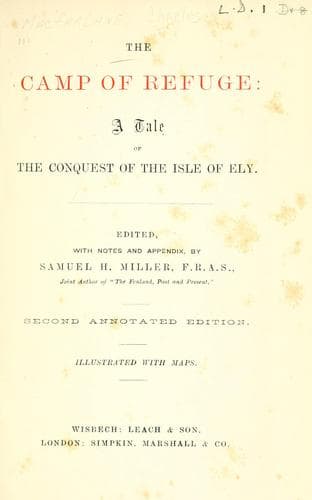
The Camp of Refuge: A Tale of the Conquest of the Isle of ElyMacFarlane, Charles
History
The Camp of Refuge: A Tale of the Conquest of the Isle of Ely
MacFarlane, Charles
Great Britain -- History -- Medieval period, 1066-1485 -- Fiction
and waiting-man, who carried great vessels in their hands, and filled
the dark horn right up to its silver rim with mead, or wine, or
pigment, every time that they presented the horn to gentle or simple.
CHAPTER XIII.
HOW LORD HEREWARD AND HIS LADIE LIVED AT EY.
Even when the marriage festival was over it was a happy and a merry
life that which they led in the good Saxon manor-house, and discreet
and orderly withal. It being the wolf-month of the year (Januarius),
when the days are still short and the nights long, Hereward and the
Ladie Alftrude, together with the whole household, rose long before it
was daylight. Before attending to any household or other duties,
prayers were said in the hall by Alefric, the good mass-priest, all the
servants of the house and all the indwelling serfs being present
thereat. Some short time after prayers the first of the four meals of
the day was served by torch or candle-light, and the lord and ladie
broke their fast; and when they had finished the meal the door of the
house was thrown open, and the poor from the neighbouring township, or
the wanderers that had no home, were admitted into the house, and the
lord and lady with their own hands distributed food among them, and
while they distributed it the mass-priest blessed the meat and said a
prayer. And this being over they went forth at early-dawn to the little
church on the hill behind the linden-grove and there heard mass. The
ladie then went home to attend unto domestic concerns, and the lord
went forth with his hawks and proper attendants to hawk by the river,
or he took forth his hounds (of that famous breed of English dogs which
hath been famed in all times, and as well for war as for hunting, and
which hath been so much coveted by foreign nations that already it
beginneth to disappear from this land), and he called together the free
men of the vicinage that loved the sport, and such of the serfs as were
best practised in it, and went well armed with _venabula_ or
hunting-spears into the fens and covers to hunt the hart and hind, or
the wild goat, or the wild bull of the fens, or the wild boar, or the
grey wolf, which was not yet extinct in these parts of England.
Public-domain text, read in full here on John Shaqi.
Reviews
Reviews
No reviews yet
Be the first to share your thoughts on this work.
Elsewhere in the archive
Join the Discussion
Join the discussion
Sign in to leave a comment or review.
Sign InorCreate an account