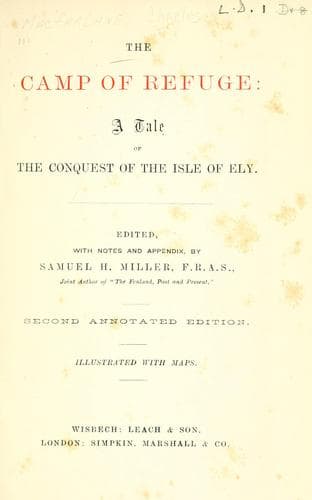
The Camp of Refuge: A Tale of the Conquest of the Isle of ElyMacFarlane, Charles
History
The Camp of Refuge: A Tale of the Conquest of the Isle of Ely
MacFarlane, Charles
Great Britain -- History -- Medieval period, 1066-1485 -- Fiction
butchered like sheep in the shambles, or are put to slow and horrible
deaths, or are mutilated in the limbs, or have their eyes put out, as
if it were no sin to spoil and destroy God’s noblest handiwork? Nay, is
not the life of a Saxon held as a thing of less price than the life of
a small deer? By our old laws, if the greatest thane in the land slew
but the poorest serf or lowliest churl, he made bot for it; but now,
and even in those parts of England where the war hath ceased, if the
meanest Norman soldier kill twenty Saxon serfs or slay a Saxon lord, no
heed is taken of it. The Saxons have no redress except that which they
may find in their own swords. Even in London city, there is one law for
the Saxons and another law for the Normans. If a Saxon be accused of
murder or robbery he is bound to justify himself according to our
ancient custom, by compurgation, and by the ordeal of red-hot iron or
boiling water; but if a Frenchman be accused of the like crime by a
Saxon, he vindicates himself by duello or single combat, or simply by
his oath, according to the law of Normandie. King Canute said, ‘Let the
free people of England manage their own townships and shires, and learn
to govern themselves; let no man apply to the king unless he cannot get
justice within his own hundred; let there be thrice a-year a
burgh-gemot, and twice a-year a shire-gemot, unless there be need
oftener; and let there be present the bishop of the shire and the
elderman, and there let both expound as well the law of God as the law
of man.’ But William the Norman alloweth not of these free things;
William the Norman consulteth not the Witan of the nation, but
governeth the country through a Norman council. When he was coming back
from his pilgrimage to Rome, King Canute sent a long letter to Egelnoth
the metropolitan,[154] to Archbishop Alfric, to all bishops and chiefs,
and to all the nation of the English, both nobles and commoners,
greeting them all, and telling them all that he had dedicated his life
to God, to govern his kingdoms with justice, and to observe the right
in all things. ‘And therefore,’ said he, ‘I beg and command those unto
whom I have entrusted the government, as they wish to preserve my good
will, and save their own souls, to do no injustice either to rich or to
poor: and let those who are noble, and those who are not, equally
obtain their rights according to their laws, from which no departure
shall be allowed either from fear of me, or through favour to the
powerful, or to the end of supplying my treasury, for _I want no money
raised by injustice_.’ But what saith this Norman William? He saith,
‘Get me all the money ye can, and heed not the means!’ And hath he not
extorted money by right and by unright? And have not his greedy
followers done worse than he in the land? And are they not building
castles everywhere to make robbers’ dens of them? And have they not
made beggars of the rich, and miserably swinked[155] the poor—aye,
Public-domain text, read in full here on John Shaqi.
Reviews
Reviews
No reviews yet
Be the first to share your thoughts on this work.
Elsewhere in the archive
Join the Discussion
Join the discussion
Sign in to leave a comment or review.
Sign InorCreate an account