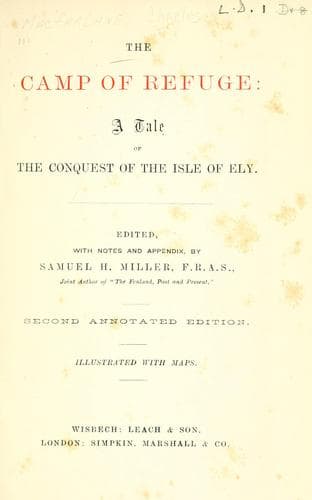
The Camp of Refuge: A Tale of the Conquest of the Isle of ElyMacFarlane, Charles
History
The Camp of Refuge: A Tale of the Conquest of the Isle of Ely
MacFarlane, Charles
Great Britain -- History -- Medieval period, 1066-1485 -- Fiction
“But, Hereward, is not all the country, save this most fenny part of
it, quietly submitting to the Conqueror! Doth not Lanfranc the
archbishop give assurance that no lasting usurpation of the goods of
the church is contemplated, and that it is his wish and intention only
to improve the Saxon church and the great and rich Saxon houses of
religion by bringing over from foreign parts some more learned priests,
and more learned and more active monks? And are not these broad lands
enough for thee and me? Nay, frown not! and might not thine own lands
at Brunn be secured if thou wouldst submit and take the peace of the
Norman ruler? Forgive me if I err, as the error all proceeds from the
love I bear thee and the dread I have of losing thee. England, we are
told, was happy under the dominion of Canute the Dane, and what was
King Canute in England but a conqueror? And if Englishmen were happy
under one foreign conqueror, might they not be happy under another?”
“Not so, sweet Alftrude. Canute was contented to govern according to
the old Saxon laws. When he gave some new laws, they were the freest
and best that were ever given until those of Edward the Confessor, and
they were given with counsel of his Witan, a free and honoured
assemblage of Saxon lords and Saxon bishops, Saxon abbats and priests,
and Saxon eldermen.[152] And in those dooms or laws King Canute,
speaking with and for the Saxon Witan, said that just laws should be
established, and every unjust law carefully suppressed, and that every
injustice should be weeded out and rooted up from this country; and
that God’s justice should be exalted; and that thenceforth every man,
whether poor or rich, should be esteemed worthy of his folk-right, and
have just dooms[153] doomed to him. And likewise did Canute, in these
dooms, which were conceived in the mild Saxon spirit, raise his voice
and set his face against death punishments and all barbarous penalties.
‘And we instruct and command,’ said he, ‘that though a man sin and sin
deeply, his correction shall be so regulated as to be becoming before
God and tolerable before men; and let him who hath power of judgment
very earnestly bear in mind what he himself desires when he thus
prays—Forgive us our trespasses as we forgive them that trespass
against us. And we command that Christian men be not, on any account,
for altogether too little, condemned to death, but rather let gentle
punishments be decreed, for the benefit of the people; and let not be
destroyed, for little God’s handiwork, and his own purchase which he
dearly bought.’ Thus said King Canute in his dooms, and in his days men
in power were made to act according to those mild laws. But how is it
now, under the Normans? My gentle-hearted bride, I would not wring thy
heart and bring tears into thine eyes, but is it not true that for any
wrong done or offence given—nay, for the allowable deed of defending
their own, and standing up for their country, Saxons of all degrees are
Public-domain text, read in full here on John Shaqi.
Reviews
Reviews
No reviews yet
Be the first to share your thoughts on this work.
Elsewhere in the archive
Join the Discussion
Join the discussion
Sign in to leave a comment or review.
Sign InorCreate an account