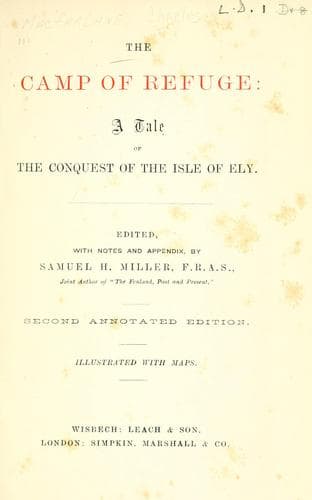
The Camp of Refuge: A Tale of the Conquest of the Isle of ElyMacFarlane, Charles
History
The Camp of Refuge: A Tale of the Conquest of the Isle of Ely
MacFarlane, Charles
Great Britain -- History -- Medieval period, 1066-1485 -- Fiction
“And with such a bride, and such a wife, I shall be invincible. Cheer
up, my own Alftrude! If submission will bring down utter ruin as well
as utter shame, a bold and persevering resistance, and an unflinching
hand-to-hand fight with the enemy, may bring her old laws and liberties
back to England, and bring to us glory and happiness, and a peaceful
and honoured life in after-times. I would be a peaceful man, even now,
if so I might, and if I had less to fight for; for, albeit, I love the
art and stratagems of war, and the rapture that is given by the
well-contested combat, I love not much blood, and never could get
myself to hate any man or parties of men, for any length of time. Were
their rule less cruel and tyrannical to the English people, and were my
good friends and allies secured in their lives, honours, and
properties, I could sit down quietly and in good fellowship with these
same Norman knights; nay, I would not refuse a seat on my hearth to Ivo
Taille-Bois, or even to his brother Geoffroy.”
“Name not that ugly name,” said the Lady Alftrude, blushing a little.
And here the discourses ended. The gentle lady had strengthened her
heart with the great love that was in it, so as to bear whatsoever
might befall her as the mate of Lord Hereward, the last champion of the
Saxon liberties.
While the lord and lady talked this above stairs, there was something
of the like discourse below stairs between the waiting-woman and the
sword-bearer; for maid Mildred, merry as she was, could not but feel
that Elfric was running a course of great peril, and that peace and
tranquility would be a blessed thing, if it could only be obtained.
Albeit the young sword-bearer spoke not so knowingly of the old Saxon
laws, and the dooms[156] of King Canute, and of Witans and Gemots, as
did his lord, he found sufficiently good arguments to show that the war
was a just and unavoidable war; and that while everything was to be
hoped from bravery, there was nothing to be gotten by a timid
submission. There was another consideration:—“But for this war,” said
Elfric, “I must have become a monk! I am now a soldier and liege-man to
Lord Hereward, and ready, as soon as the lord and ladie permit, to be
thy loving husband, oh Mildred of Hadenham!”
CHAPTER XIV.
HEREWARD IS MADE KNIGHT.
Public-domain text, read in full here on John Shaqi.
Reviews
Reviews
No reviews yet
Be the first to share your thoughts on this work.
Elsewhere in the archive
Join the Discussion
Join the discussion
Sign in to leave a comment or review.
Sign InorCreate an account