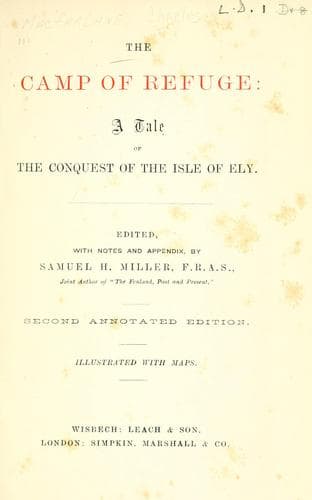
The Camp of Refuge: A Tale of the Conquest of the Isle of ElyMacFarlane, Charles
History
The Camp of Refuge: A Tale of the Conquest of the Isle of Ely
MacFarlane, Charles
Great Britain -- History -- Medieval period, 1066-1485 -- Fiction
Before the marriage festival was well ended, the festival of the
Epiphany arrived. The Lord of Brunn could not go to Ely; but he was now
in constant correspondence with the good Lord Abbat and the prelates
and lay nobles there; and in sending off his last Norman prisoners, he
had sent to tell the abbat that he must hold him excused, and that he
would eat the paschal lamb with him, hoping before the Easter festival
to have gained many more advantages over the Normans. The returning
messenger brought Hereward much good advice and some money from Ely.
Among the many pieces of good counsel which the Abbat Thurstan gave was
this, that the young Lord of Brunn should lose no time in getting
himself made a lawful soldier or knight, according to the forms and
religious rites of that Saxon military confraternity which had been
authorised by the ancient laws of the country, and which had existed
long before the Normans came into England with their new-fashioned
rules and unholy rites. The great lay lords at Ely and in the Camp of
Refuge had all been initiated, and their swords had been blessed by
Saxon priests; and as all these knights and lords had agreed in
appointing Hereward to the supreme command, it behoved him to be
inaugurated in the Saxon knighthood; otherwise there would be a mark of
inferiority upon him, and people might proclaim that he was not a
lawful soldier. Now the young Lord of Brunn had thought well of these
things before, and had been reminded of them by the taunting Normans.
Any Lord Abbat or other prelate could perform the rites. The Abbat of
Crowland had now returned to his house, and would rejoice to confer the
honour upon Hereward; but Hereward’s own uncle, and by his father’s
side, was Lord Abbat of Peterborough;[157] and not only was it more
suitable that the rites should be performed by him and in his church,
but also was it urgent that the young Lord of Brunn should march
speedily upon Peterborough in order to rescue his kinsman and the Saxon
monks that yet lived under his rule from the oppression and tyranny of
the Normans. This uncle of Hereward and Lord Abbat of Peterborough,
whose secular name was Brand, had been sundry times plundered and
maltreated, and now expected every day to be dispossessed. Brand had
not long been Lord Abbat, and he had put on the Peterborough mitre, of
silver gilded, at a time of the greatest trouble. His predecessor the
Abbat Leofric[158] had gone forth with the English army of King Harold;
and, after Hastings, he had sickened, and returning unto Peterborough,
he had died on the night of Allhallow mass: God honour his soul! In his
day was all bliss and all good at Peterborough. He was beloved of all.
But afterwards, as we shall see, came all wretchedness and all evil on
the minster: God have mercy on it! All that he could do had been done
by good Leofric’s successor. Abbat Brand had given a large sum of money
to Duke William, in the view of keeping the house and convent free from
molestation.
Public-domain text, read in full here on John Shaqi.
Reviews
Reviews
No reviews yet
Be the first to share your thoughts on this work.
Elsewhere in the archive
Join the Discussion
Join the discussion
Sign in to leave a comment or review.
Sign InorCreate an account