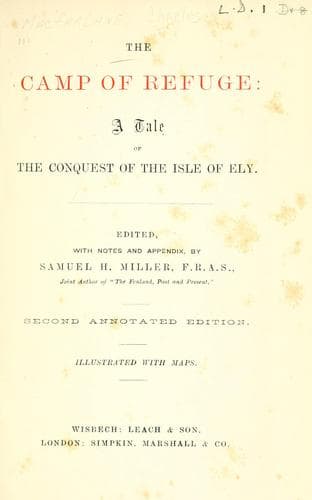
The Camp of Refuge: A Tale of the Conquest of the Isle of ElyMacFarlane, Charles
History
The Camp of Refuge: A Tale of the Conquest of the Isle of Ely
MacFarlane, Charles
Great Britain -- History -- Medieval period, 1066-1485 -- Fiction
As the paschal festival approached, Hereward received various urgent
messages from the Abbat of Ely. These messages did not all relate to
the coming festivity, and the promise of the Lord of Brunn to be the
Lord Abbat’s guest: while Hereward had been beating the Normans, and
gaining strength on the side of Peterborough and Stamford, the Normans
had been making themselves very strong at Cam-bridge, and were now
threatening to make another grand attack upon the Camp of Refuge from
that side. Abbat Thurstan therefore required immediate assistance, and
hoped that Hereward would bring with him all the armed men he could.
Moreover, jealousies and heartburnings had again broken out among the
Saxon chiefs, who had all pledged themselves to acknowledge the supreme
authority of the Lord of Brunn. If Hereward would only come, these
dissensions would cease. Other weighty matters must be discussed; and
the discussion would be naught if Hereward were not present. Thus
strongly urged, Hereward left his young wife in his house at Brunn, and
taking with him nearly three hundred armed men, he began his march down
the Welland in the hope of raising more men in that fenniest of the
fen-countries, which lies close on the Wash, and with the intention of
crossing the Wash, and ascending the Ouse in ships and boats. It
grieved him to leave the Ladie Alftrude, and much did it grieve Elfric
his sword-bearer to quit maid Mildred; but Hereward thought that his
wife would be safe in his strong house at Brunn, and Elfric was made
happy by the assurance that as soon as they came back again he should
be allowed to marry Mildred. The Ladie Alftrude had shed a few tears,
and her handmaiden had made sundry louder lamentations; but the lady
was full of heart and courage and hope, nor did the maid lament out of
any fear.
Public-domain text, read in full here on John Shaqi.
Reviews
Reviews
No reviews yet
Be the first to share your thoughts on this work.
Elsewhere in the archive
Join the Discussion
Join the discussion
Sign in to leave a comment or review.
Sign InorCreate an account