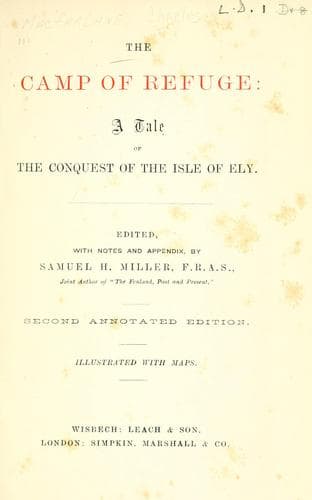
The Camp of Refuge: A Tale of the Conquest of the Isle of ElyMacFarlane, Charles
History
The Camp of Refuge: A Tale of the Conquest of the Isle of Ely
MacFarlane, Charles
Great Britain -- History -- Medieval period, 1066-1485 -- Fiction
When the Lord of Brunn moored his little fleet of barks, and raised his
standard on the shores of the Wash, many more good fen-men came
trooping to him, as he had expected. Many came from Hoiland.[161] And
how did they come? They came marching through the mires and waters upon
high stilts, looking all legs, or, at a distance, like herons of some
giant breed. Voyagers have related that in that sandy country which
lies along the Biscayan gulf, and between Bordeaux and Spain, men and
women and children all walk upon high stalking poles or stilts, as the
only means of getting across their soft, deep sands; and here, in the
most marshy part of the fens, men, women, and children were trained to
use the same long wooden legs, not to get over dry loose sand, but to
get over water and quagmire, and broad and deep ditches. These stilted
men of Hoiland, who were all minded to go help in the Camp of Refuge,
threw their stilts[162] into Lord Hereward’s bark; which was as if men
of another country should throw away their legs, for without these
stilts, we ween, there was no walking or wayfaring in Hoiland: but the
thing was done to show that they were devoted to the good cause and put
an entire trust in the victorious Lord of Brunn, and that they would go
with him, legs, arms, and hearts, wherever he might choose to lead them.
At Lynn, on the other side of the Wash, still more Saxons joined Lord
Hereward’s army, some of them coming in boats, and some marching by
land. Ha! had there been but five Herewards in England, England would
have been saved!
It was on the eve of the most solemn, yet most joyous festival of
Pasche, or on the 24th day of the month Aprilis, in the year of grace
one thousand and seventy-one, that the Lord of Brunn, arrived with his
host at the great house of Ely, to the inconceivable joy of every true
Saxon heart that was there. Pass we the welcome and the feast, and come
we to the councils and deliberations in the Aula Magna of the house. On
the third day after the paschal Sunday all the Saxon lords and chiefs,
prelates and cloister-monks, met early in the morning, or immediately
after prime, and ceased not their deliberations until the dinner hour.
On one great point there was no difference of opinion—the victorious
Lord of Brunn was to hold supreme command over all the troops and
bands, of whatsoever description, collected in the Camp of Refuge, and
have the entire management of the war wherever it should be carried. On
other heads of debate opinions were very various, but the greatest
divergency of all was upon the question whether the Danes should or
should not be invited again to the assistance of the Saxons. When all
had spoken on the one side or the other, and with much vehemence of
speech, the Lord of Brunn, who had been forced to correct his taciturn
habits, and to speak on many occasions at greater length than he had
ever fancied he should speak, rose and said—
Public-domain text, read in full here on John Shaqi.
Reviews
Reviews
No reviews yet
Be the first to share your thoughts on this work.
Elsewhere in the archive
Join the Discussion
Join the discussion
Sign in to leave a comment or review.
Sign InorCreate an account