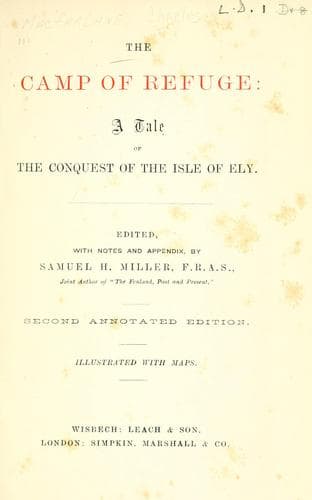
The Camp of Refuge: A Tale of the Conquest of the Isle of ElyMacFarlane, Charles
History
The Camp of Refuge: A Tale of the Conquest of the Isle of Ely
MacFarlane, Charles
Great Britain -- History -- Medieval period, 1066-1485 -- Fiction
“I fought in that battle,” quoth Hereward, “and know that it was a
mixed army of Danes and Norwegians, even like most of the armies that,
for two hundred years and more, devastated this land and the kingdom of
Scotland. But let that pass. Those armies came as open enemies: let us
see the conduct of an army that came as friends. Only last year the
good Saxon people from the Tyne to the York Ouse were deserted in the
hour of success and victory by an army of Danes, commanded by the
brothers of the King of Danemarck, who had been invited into the
country by the suffering Saxons, and who had sworn upon the relics of
saints not to leave this land until it was clear of the Normans. The
two royal Danes took the gold of the son of Robert the Devil and the
harlot of Falaise, and thereupon took their departure in their ships,
and left the Saxons, with their plan all betrayed, to be slaughtered in
heaps, and the whole north country to be turned into a solitude and
desert, a Golgotha, or place of skulls.”
“This is too true,” said the Bishop of Durham; “and terrible is all
this truth!”
“But,” said the Bishop of Lindisfarne, “the King of Danemarck’s
brothers are not the King of Danemarck himself. We hear that the king
is incensed at what those brothers did, and that he hath banished them
from his presence and from the land of Danemarck, and that he hath
sworn by the rood[163] that he will send four hundred keels across the
ocean, and take himself the command of the army.”
“Yet even if he come,” quoth the Lord of Brunn, “he may prove as
faithless and as greedy for gold as his brothers; or he may set up his
pretended right to the throne of King Harold, our absent but not lost
lord, and in that case we shall find that the Saxon people will fall
from our side; for if they are to be cursed with a new and foreign
master, they will not overmuch care whether his name be William of
Normandie or Svend of Danemarck.”
“Assuredly not quite so,” said the Prior of Ely, who opposed Hereward
the more because the Lord Abbat Thurstan was disposed to agree with
him; “assuredly not quite so, my Lord of Brunn, for there hath been
large admixture of Danish blood in our Anglo-Saxon race,[164] and Danes
and English sprang, _ab origine_, from nearly one and the same great
hive of nations in the north.”
Public-domain text, read in full here on John Shaqi.
Reviews
Reviews
No reviews yet
Be the first to share your thoughts on this work.
Elsewhere in the archive
Join the Discussion
Join the discussion
Sign in to leave a comment or review.
Sign InorCreate an account