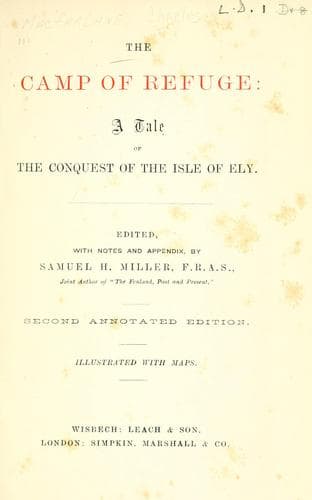
The Camp of Refuge: A Tale of the Conquest of the Isle of ElyMacFarlane, Charles
History
The Camp of Refuge: A Tale of the Conquest of the Isle of Ely
MacFarlane, Charles
Great Britain -- History -- Medieval period, 1066-1485 -- Fiction
“Prelates and chiefs, ancients and younger men, if one so young as
myself may deliver opinions in this assemblage, I would say let us
take heed ere we tamper any more with Danemarck. The woes of the
Anglo-Saxons first began when the Danes crossed the seas in their
nailed ships and came among them first to rob and plunder, and next to
seek a settlement in this fat and fertile land of England. Our rubric
is filled with Saxon martyrs butchered by the Danes. This noble house
of religion where we now consult was plundered and burned by the
Danes; and the Danes slew all the ancient brotherhood of the house,
and did the foulest things upon the tombs of the four Saxon virgins
and saints—Saint Etheldreda, Saint Sexburga, Saint Ermenilda, Saint
Withburga. I am lately from the Abbey of Peterborough, where I read
upon the monumental stones the names of the good Saxon abbats and
monks of that house that were murthered by the Danes. The same thing
happened at Crowland, and at fifty more religious houses. The Danes
have been the great makers of Saxon martyrdoms. The worst famed of our
Saxon kings are those who submitted to them or failed in conquering
them; the name of King Alfred is honoured chiefly for that he defeated
the Danes in an hundred battles, and checked their rapacity and
blood-thirstiness.”
“Oh, Hereward of Brunn!” said the bishop of Lindisfarne, “this is all
true; but all this happened when the Danes were unconverted Pagans.”
“But good my Lord Bishop of Lindisfarne,” quoth the Lord of Brunn, “let
us note well the conduct of the Danes since they have been Christian
men, and we shall find as Saxons that we have not much to praise them
for. Had it not been for the unmeet alliance between Lord Tostig and
the strangers, and the invasion of Northumbria and York, and the need
King Harold lay under of breaking that unholy league, and fighting
Tostig in the great battle by Stamford Bridge, King Harold would never
have been worsted at the battle of Hastings, for his armed forces would
have been entire, and fresh for the fight, instead of being thinned as
they were by that first bloody combat, and worn out by that long march
from York unto Hastings.”
“It was an army of Norwegians that fought King Harold by Stamford
Bridge,” said the Prior of Ely.
Public-domain text, read in full here on John Shaqi.
Reviews
Reviews
No reviews yet
Be the first to share your thoughts on this work.
Elsewhere in the archive
Join the Discussion
Join the discussion
Sign in to leave a comment or review.
Sign InorCreate an account