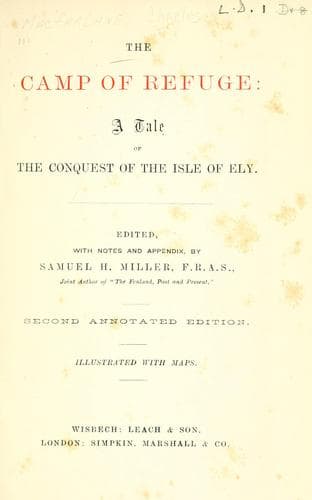
The Camp of Refuge: A Tale of the Conquest of the Isle of ElyMacFarlane, Charles
History
The Camp of Refuge: A Tale of the Conquest of the Isle of Ely
MacFarlane, Charles
Great Britain -- History -- Medieval period, 1066-1485 -- Fiction
But there were many there that would not take my Lord Abbat’s word, and
that would not be persuaded by the arguments of the Lord of Brunn; and
in an inauspicious hour it was determined to send an embassage from the
lords and prelates in the Camp of Refuge to the king and lords and free
rovers of Danemarck, to implore their aid and assistance, and to
present them with a sum of money, as the earnest of a large future
reward. The strong money-box at the shrines of Ely church, wherein the
pilgrims deposited their offerings, was now in reality broken open and
emptied; at which some of the unworthy members of the house who had
most opposed Hereward and their Lord Abbat went about whispering and
muttering, in the corners of the cloisters, and even among the townfolk
of Ely, that sacrilege had been committed. Yet was the total sum thus
procured so very disproportionate to the well-known appetites of the
Danes for money, that a collection was made in the Camp of Refuge, and
even Jews were secretly invited from Norwich and St. Edmundbury in
order to see whether they could be tempted to advance some money upon
bonds: and here were raised fresh whisperings and murmurings about
impiety, together with severe censures on Abbat Thurstan for want of
uniformity or consistency of conduct, seeing that he had formerly been
the sworn foe to all the Israelites whom the Normans had brought over
in their train; and that, nevertheless, the convent were now sending
for the Jews to open accounts and dealings with them. It suited not
these back-biters to remember that they themselves, in determining that
the aid of the Danes should be required, had agreed that money should
and must be sent to them; and that when Abbat Thurstan said there was
but very little money in the house, they themselves had recommended
sending for the Israelites who made a trade of usury. All points
connected with the unhappy business had been decided, after the public
discussions in the hall, by the members of the house in close chapter,
wherein the Lord Abbat had only given his vote as one. But these
unfaithful monks and untrue Englishmen hoped to make people believe
that their opinions had been overruled, and that Thurstan was
answerable for everything.
It was also noticed—although not by the abbat and the monks that were
faithful unto him, and that were never allowed to hear any of the
whisperings and murmurings—that several of those who had most eagerly
voted for calling in the assistance of the Danes shrugged their
shoulders whenever men mentioned the expected invasion of the fen
country and the new attack on the Camp of Refuge, and spoke of the
Norman as a power too formidable to be resisted by the English, or by
any allies that the English could now procure.
CHAPTER XV.
THE CASTLE AT CAM-BRIDGE AND A BATTLE.
Public-domain text, read in full here on John Shaqi.
Reviews
Reviews
No reviews yet
Be the first to share your thoughts on this work.
Elsewhere in the archive
Join the Discussion
Join the discussion
Sign in to leave a comment or review.
Sign InorCreate an account