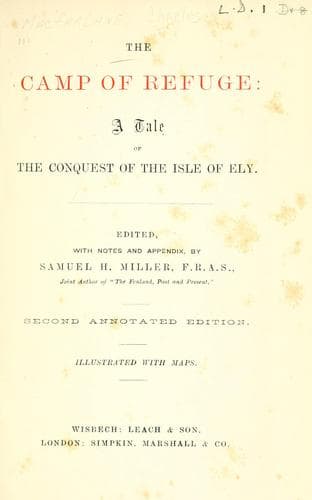
The Camp of Refuge: A Tale of the Conquest of the Isle of ElyMacFarlane, Charles
History
The Camp of Refuge: A Tale of the Conquest of the Isle of Ely
MacFarlane, Charles
Great Britain -- History -- Medieval period, 1066-1485 -- Fiction
When the Normans first came into England, the town of Cam-Bridge, or
Grant-Bridge, was not the stately town which we have seen it since, nor
was it the flourishing place which it had been in the time of the Saxon
Heptarchy.[165] According to the Venerable Bede, Sebert, or Sigebert,
King of the East Angles, by the advice of Felix the Bishop, instituted
within his kingdom a school for learning, in imitation of what he had
seen in France; and this school is believed to have been fixed on the
very spot where the town of Cam-Bridge now stands.[166] Others there
are who say that a school had flourished there in the time of the
Romans, and that Sebert, or Sigebert, only restored this school in the
year of our Lord six hundred and thirty. Certain it is that from a very
early time Cam-Bridge was the residence of many students, who at first
lived in apartments hired of the townspeople, and afterwards in inns or
hostels of their own, where they formed separate communities, of which
each was under its own head or principal. But in the fiery distraction
of the Danish invasion of England, when abbats and monks and religious
women were slaughtered at the feet of their own altars, and churches
and abbeys and monasteries consumed, the pagan flames fell upon this
quiet seat of learning, and left nothing behind but ashes and ruins.
After this the place lay a long time neglected. There are some who
write that when, about the year of grace nine hundred and twenty, King
Edward, surnamed the Elder, and the eldest son and successor of Alfred
the Great, repaired the ravages of the Danes at Cam-Bridge, he erected
halls for students, and appointed learned professors; but these facts
appear to be questionable, and it is thought that, although learning
would no more abandon the place than the waters of the river Cam would
cease to flow by it, the scholars were in a poor and insecure
condition, and were living not in the halls or colleges of stately
architecture, but under the thatched roofs of the humble burghers, when
the blast of the Norman trumpets was first heard in the land. At that
sound all humane studies were suspended. The town and territory round
it were bestowed upon a Norman chief, and Norman men-at-arms were
quartered in the houses which had lodged the students. But it was not
until the third year after the battle of Hastings, when Duke William
became sorely alarmed at the great strength of the Saxons, gathered or
still gathering in the neighbouring isle of Ely, that Cam-Bridge felt
to their full extent the woes attendant on wars and foreign conquest.
Then it was made a great military station, and a castle was built to
lodge more soldiers, and command and control the town and all the
vicinity. Just beyond the river Cam, and opposite to the little
township, there stood, as there still stands, a lofty barrow or mound
of earth,[167] overgrown with green sward, and looking like those
mounds which the traveller observes by Salisbury plains, and on the
Public-domain text, read in full here on John Shaqi.
Reviews
Reviews
No reviews yet
Be the first to share your thoughts on this work.
Elsewhere in the archive
Join the Discussion
Join the discussion
Sign in to leave a comment or review.
Sign InorCreate an account