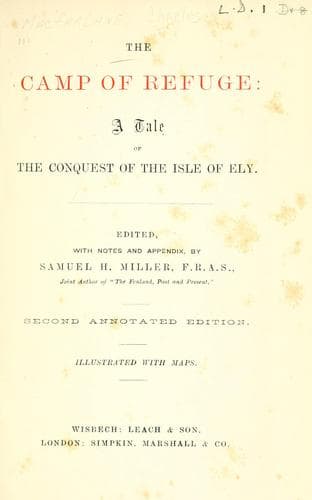
The Camp of Refuge: A Tale of the Conquest of the Isle of ElyMacFarlane, Charles
History
The Camp of Refuge: A Tale of the Conquest of the Isle of Ely
MacFarlane, Charles
Great Britain -- History -- Medieval period, 1066-1485 -- Fiction
On the midnight which followed the feast of Saint Bede the Normans
began to issue from their castle and camp. There shone a bright moon
along the causeway where they formed their array. First went a great
troop of horse with lances and long pennants floating from them. Next
went a body of archers bearing long bows and quivers well stocked with
long arrows. Then followed a large and miserable company of Saxon serfs
and hinds, who had been forcibly impressed into the service, and who
were laden like beasts of burthen, carrying stores and provisions on
their backs, and hurdles, and planks, and other pieces of timber, by
means of which these too confident Normans hoped to be able to cross
every ditch, stream, and river. After this unhappy company there
marched another band of archers; and then there went another and still
greater body of horse; and in the rear of all were more bowmen. As the
raised road was very narrow the horsemen marched only two abreast, and
the footmen only three abreast; and thus, as the total number of the
army was great, the line was very long and thin; and the knights riding
in the rear would seldom either hear or see what was passing in the
van. Yet merrily and thoughtlessly they went on singing their Norman
war-songs, their bridles ringing sharp and clear in the cool night air
as if to accompany the music of their songs, and their bright
lance-heads glinting in the moon-light: thus merrily and thoughtlessly
until the van came abreast of Fenny Ditton, where the road or causeway
was flanked on either side by a broad deep ditch or canal, and by a
long belt of thick growing willows and alders. But here Eustache, and
the other knights that rode in the van, heard a loud voice shouting in
very good Norman-French—“Halt, horse and foot! No farther to-night!
Saxons true do forbid your advance!” And, well nigh at the same moment
those knights and soldiers that rode in the rear heard another loud
voice shouting—“Halt, Normans! Halt ye must, but ye shall not get back
to Cam-Bridge unless ye can swim the ditch.” It seemed as though some
hollow willow-trees had spoken, for neither in front nor rear was there
a man seen. But presently the loud voices spoke again, and a still
louder voice was heard about mid-way between the two, and all the three
voices cried—“Saxons, your bow-strings to your ears, and next a charge
for England and Lord Hereward!” As soon as these words were heard in
the centre, the Saxon serfs, whom the Normans had impressed, threw the
provisions and stores they carried right across the broad ditches;
threw down the hurdles and beams and timber on the road, and then, with
a wild yell, rushed into the water and swam across to the covering of
the trees. But in the centre those trees were all alive before these
men reached them, and no sooner were they seen to be safe than a rush
was made towards the ground which they had abandoned. All fen-men swim,
but to make their passage the quicker light bridges were laid across
Public-domain text, read in full here on John Shaqi.
Reviews
Reviews
No reviews yet
Be the first to share your thoughts on this work.
Elsewhere in the archive
Join the Discussion
Join the discussion
Sign in to leave a comment or review.
Sign InorCreate an account