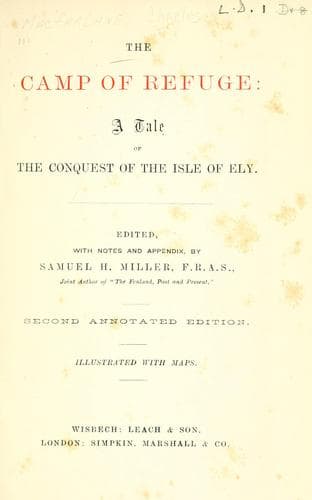
The Camp of Refuge: A Tale of the Conquest of the Isle of ElyMacFarlane, Charles
History
The Camp of Refuge: A Tale of the Conquest of the Isle of Ely
MacFarlane, Charles
Great Britain -- History -- Medieval period, 1066-1485 -- Fiction
Much did these Normans pretend to despise our Saxon fathers for their
ignorance of the stratagems of war, and for their general dulness: and
yet it must be confessed that they themselves gave very many proofs of
ignorance and dulness, as well as of great negligence, the fruit of the
unwise contempt in which they held their adversaries. Before the
arrival of Eustache some few of the Normans had ridden along the
causeway as far as they could conveniently go on horseback, but for the
state of the country beyond their ride they trusted to mere report,
taking no pains whatever to inform themselves accurately. They had all
been told of the extraordinary deeds which Hereward had performed, but
they gave the whole merit of these exploits to Crowland devils and
other fiends and goblins that were not to be feared in summer weather
or in daylight. They had been told that the Lord of Brunn was a
well-skilled commander, but they would not believe that any Saxon
whatsoever could be a great soldier. Instead of being cautious and
silent as to their intended attack, they had been loudly proclaiming it
on every side. Certes, Duke William was a knowing soldier himself, and
one that did great things in war, being cautelous and discreet; but,
wherever he was not, his chiefs in command did not much. It was rather
for the sake of avoiding the heat of the day than for any other reason
that Eustache resolved to begin his march at midnight. He did not think
of surprising the Saxons, and, as for being surprised by them, he
scornfully laughed at the notion. He wished, he said, that the rebels
and traitors should know that he was coming, in order that they might
collect all their forces in the camp, and so afford him the opportunity
of destroying them all at one blow. His chief fear was that Hereward
the Saxon would flee from the mere terror of his name.
Public-domain text, read in full here on John Shaqi.
Reviews
Reviews
No reviews yet
Be the first to share your thoughts on this work.
Elsewhere in the archive
Join the Discussion
Join the discussion
Sign in to leave a comment or review.
Sign InorCreate an account