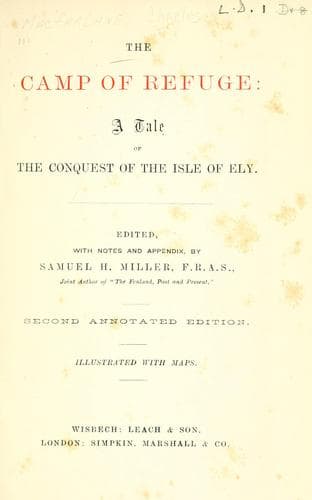
The Camp of Refuge: A Tale of the Conquest of the Isle of ElyMacFarlane, Charles
History
The Camp of Refuge: A Tale of the Conquest of the Isle of Ely
MacFarlane, Charles
Great Britain -- History -- Medieval period, 1066-1485 -- Fiction
Great had been the wrath excited among the Normans by that last great
act of Abbat Brand’s life—the Saxon knighthood of Lord Hereward. Duke
William had sworn by the splendour of God that the abbat should rue the
day on which he had given his benediction to the sword of a rebel; but
a greater than kings had saved good Brand from this kingly fury. When
he knew that he was dead, William named as his successor that terrible
Norman, the Abbat Torauld[172] of Fescamp, who always wore a coat of
mail under his rochet, and who wielded the sword and battle-axe much
oftener or much more willingly than he carried the crosier.[173] This
terrible Torauld had been wont to govern his monks even in foreign
parts as captains govern their turbulent soldiery; and whenever any
opposition was offered to him, it was his custom to cry, “Come hither,
my men-at-arms!” and upon men-at-arms he always depended for the
enforcing of his ecclesiastical discipline. Where he ruled there were
few penances except such as were inflicted with his own hand; for he
was a very choleric man, and would smite his monks and novices over
their fleshiest parts with the flat of his heavy sword, and tweak their
noses with his sharp steel gloves, and strike them over their shaven
crowns with his batoon. Terrible as a man, and still more terrible as
an abbat, was this same Torauld of Fescamp! Monks crossed themselves,
and said _Libera nos_, whenever his name was mentioned. Now Duke
William told this terrible Torauld that as Peterborough was so near to
the turbulent Fen Country, and so little removed from the Camp of
Refuge, it was a place well suited to an abbat who was so good a
soldier, and that a soldier rather than an abbat was wanted to preside
over that abbey. And Torauld was farther told, by Ivo Taille-Bois, who
was roaring, like a bear bereft of her cub, for the loss of the
manor-house at Spalding, that on arriving at Peterborough he must take
good care to disinter the Abbat Brand, and throw his body upon the dung
heap; that he must well scourge the monks for their past contumacy, and
make a quick clutch at such treasure as might yet remain within the
house, seeing that the Norman troops were greatly distressed by reason
of their poverty, and that, notably, he, the Vicomte of Spalding, had
not a denier.[174]
“_Factum est_,” said Torauld, “consider all this as done.”
Public-domain text, read in full here on John Shaqi.
Reviews
Reviews
No reviews yet
Be the first to share your thoughts on this work.
Elsewhere in the archive
Join the Discussion
Join the discussion
Sign in to leave a comment or review.
Sign InorCreate an account