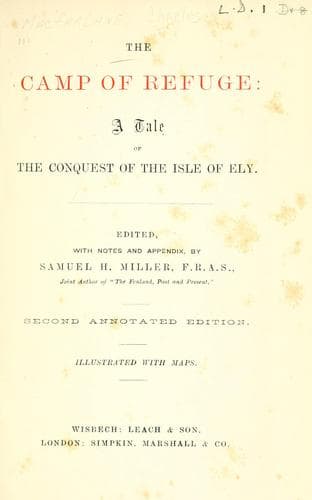
The Camp of Refuge: A Tale of the Conquest of the Isle of ElyMacFarlane, Charles
History
The Camp of Refuge: A Tale of the Conquest of the Isle of Ely
MacFarlane, Charles
Great Britain -- History -- Medieval period, 1066-1485 -- Fiction
And in order that it might be done the more easily, Ivo Taille-Bois
superadded one hundred and forty men to those that the fighting abbat
brought with him, thus making Torauld’s whole force consist of one
hundred and sixty well-armed Frenchmen. At the head of this little
army, with sword girded round his middle and with battle-axe tied to
his saddle-bow, the monk of Fescamp began his march from Stamford Town.
As soon as the disloyal monks heard that he was coming, they drove away
by main force the very few Saxon soldiers that remained about the
house, and began to prepare sackcloth and ashes for themselves, and a
sumptuous feast for the Abbat Torauld, hoping thereby to conciliate
him, and make him forget the bold doings of my Lord Abbat Brand.
But before that uncanonical abbat and his men-at-arms could get half
way to Peterborough,[175] the Lord Hereward, who had been duly apprised
of all these late proceedings and intentions, arrived at the abbey with
Elfric his sword-bearer, and about three-score fighting men; and before
the monks could make fast their gates he was within the house. There be
some who do say that the entrance was not got without a fight, and that
some of my Lord Hereward’s people set fire to a part of the monastery;
but I ween there was no fighting or beating of monks until Torauld,
that very stern man, got possession of the house, and that there was no
fire until a time long after the visit of the Saxons, when the monks of
Peterborough, being disorderly and drunken, set fire to the house
themselves by accident. The Lord of Brunn made straight for the house
which King Etheldred of happy memory had built for the Lord Abbats. A
building it was very large and stately; all the rooms of common
habitation were built above-stairs, and underneath were very fair
vaults, and goodly cellars for sundry uses; and the great hall above
was a magnificent room, having at the upper end, in the wall, very high
above the floor, three stately thrones, whereon were seated the
effigies of the three royal founders, carved curiously in wood, and
painted and gilt.[176] In this hall stood Hereward and his merry men.
Little did the monks wot of this visit. They thought the Lord of Brunn
was many a league off, fighting in the fens; and when he came among
them like one dropped from the clouds, and they saw in his honest,
plain-speaking face that he was angered, the traitors began to blush,
and some of them to turn pale; and when this first perturbation was
over, they began to welcome him in the very words of a speech they had
prepared for the welcoming of Torauld. But Hereward soon cut their
speech short, and asked the prior of the house what was become of the
twenty men he had left there for the protection of the house. The prior
said that the men had behaved in a riotous manner, eating and drinking
all the day long, and had deserted and run away because they had been
reproved.
Public-domain text, read in full here on John Shaqi.
Reviews
Reviews
No reviews yet
Be the first to share your thoughts on this work.
Elsewhere in the archive
Join the Discussion
Join the discussion
Sign in to leave a comment or review.
Sign InorCreate an account