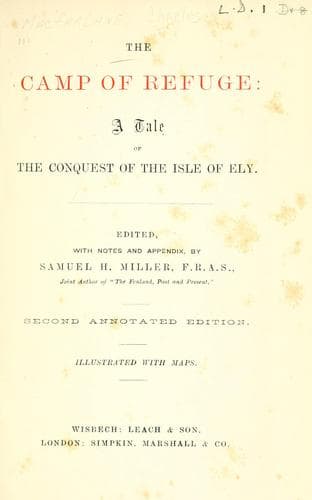
The Camp of Refuge: A Tale of the Conquest of the Isle of ElyMacFarlane, Charles
History
The Camp of Refuge: A Tale of the Conquest of the Isle of Ely
MacFarlane, Charles
Great Britain -- History -- Medieval period, 1066-1485 -- Fiction
“It likes me not to call a priest a liar, but this is false!” said the
Lord of Brunn; “thou and thy French faction have driven away those
honest men; and here be some of them to speak for themselves, and to
tell thee, oh prior, how busy thou hast been ever since the death of my
good uncle (peace to his soul!) in preparing to make terms with the
French—in preparing to welcome the shaven cut-throat that is now
a-coming to rule over this house!”
The men stood forward, and the loyal part of the monks (alas! that they
were so few) stood forward also, and told the traitors to their faces
all that they had been doing. The prior and the chamberlain, the
refectorarius and the rest of the officials, then began to excuse
themselves on the plea of their weakness, and on the plea of the great
danger in which they stood.
“You confess, then,” said Hereward, “that you cannot of yourselves
defend this house and its shrines?”
“Of a surety we confess it,” said the prior; “nor is this house to be
held against the Normans even with a garrison of armed men.
Peterborough is not Ely, good my lord! _There_ Saxon monks may hold
their own; but _here_ it cannot be done.”
“So ho!” quoth Hereward, “this is where I would have thee! and
therefore, oh prior, since thou canst not keep thy gilded crosses and
silver vessels, thy chalices and pateras, thy drapery and rich church
hangings, and as all these things and all other the property of this
house will fall into the hands of the Norman thieves if they are not
removed, I will and must carry them all off to Ely, where thou allowest
they will be in safe Saxon keeping.”
“Wouldst thou despoil the temple of the Lord? Wouldst thou rob the
shrines of Saxon saints?” said the sacrist.
“My Lord of Brunn, thou darest not do the deed,” said the prior.
“It is not for thee, false monk! to set the limits to my daring, when
my conscience sanctions that which I am doing, and when the cause of my
country urges it to be done,” said Hereward.
“I will excommunicate thee as a sacrilegious robber,” said the prior.
“Archbishop Stigand, the true primate of England, will excommunicate
thee as a traitor to his country and traitor to his church,” quoth the
Lord of Brunn. “But I have little time to waste in words. Come, my
merry men, be stirring! pack up all the plate, and all the hangings,
and everything that we can carry with us.”
“They shall not have the keys,” said the chamberlain or treasurer of
the house.
“We have them already,” quoth Elfric, who had been led to the
chamberlain’s cell by one of the true Saxon monks. “We have the keys
already, and so have we the engraven seals of silver gilt. The sigillum
of so good a man as Abbat Brand shall never be used by so bad a man as
Torauld. See! here it is, my lord!” And so saying Elfric handed the
good massive seal to his master, who kissed it as though it had been a
relic, and then put it in his bosom.
Public-domain text, read in full here on John Shaqi.
Reviews
Reviews
No reviews yet
Be the first to share your thoughts on this work.
Elsewhere in the archive
Join the Discussion
Join the discussion
Sign in to leave a comment or review.
Sign InorCreate an account