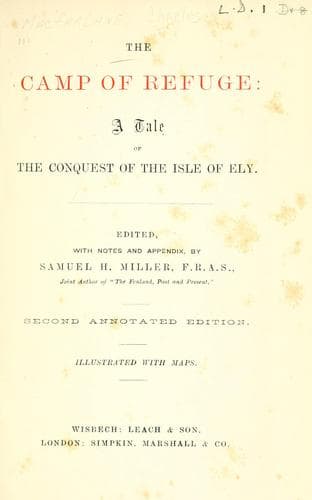
The Camp of Refuge: A Tale of the Conquest of the Isle of ElyMacFarlane, Charles
History
The Camp of Refuge: A Tale of the Conquest of the Isle of Ely
MacFarlane, Charles
Great Britain -- History -- Medieval period, 1066-1485 -- Fiction
“Now write me at the bottom of this scroll a receipt and declaration,”
said the Lord of Brunn to the sub-sacrist. “Say that I, Hereward the
Saxon, have taken away with me into the Isle of Ely, and unto that
hallowed house of the true Saxon Abbat Lord Thurstan, all the things
above enumerated. Say that I have removed them only in order to save
them from the thievish hands of the Normans, or only to prevent their
being turned against ourselves—say that I swear by all my hopes of
life eternal to do my best to restore them uninjured so soon as the
Normans are driven out of England; and say that I will make bot for
every loss and for every injury. Mortal man can do no more than this.”
The sub-sacrist, maugre the threats and maledictions of his superior
the sacrist, and of the prior and refectorarius, and all the upper
officials, quickly engrossed on the parchment all that the Lord of
Brunn wanted; and Hereward, being himself a scholar and penman, signed
it with his name. Next he called for signatures of witnesses. Girolamo
of Salerno wrote a _sic subscribitur_, and wrote his signature, and
Elfric, who had improved as much in learning as in the art of war, did
the same. Some others made the sign of the cross opposite to their
names that were written for them; but upon the whole it was a good
receipt, and solemn and well witnessed. The Lord of Brunn handed the
parchment to the prior, bidding him to take care of it, and show it to
his new abbat Torauld as soon as that Frenchman should arrive with his
one hundred and sixty men-at-arms; but the prior cast the parchment
upon the ground, saying that the house was impiously spoiled—that
nothing would ever be gotten back again—that nothing was left in the
house but woe, nakedness, and tribulation.
“Oh prior!” said Hereward, and he smiled as he said it—“oh untrue and
un-Saxon prior! the savoury odours that come upwards from thy kitchen
tell me that there is something more than this. By saint Ovin! it is
not Torauld of Fescamp and his men-at-arms that shall eat this thy
feast! Elfric, see those viands served up in the refectory, and we will
eat them all, be they cooked or uncooked, done or underdone.”
“My Lord,” responded Elfric, “the roast meats be done to a turn, the
boiled meats and the stewed meats, and fowl and fish be all ready. The
cook of this house of Peterborough, being no caterer for Normans, but a
Saxon true, and one that hath owed his promotion to thine uncle, of
happy memory, the Abbat Brand, hath seen to all these things, and hath
advanced the good dinner by an hour or twain.”
“Then for love of mine uncle’s nephew, let him dish up as quickly as
may be! Elfric, what say thy scouts? Where be the Frenchmen now?”
“Good ten miles off, my lord; so do not over-hurry the meal.”
“Prior, sacrist, chamberlain, traitors all!” said Lord Hereward, “will
ye do penance with us in eating of this feast which ye had prepared for
Norman stomachs?”
Public-domain text, read in full here on John Shaqi.
Reviews
Reviews
No reviews yet
Be the first to share your thoughts on this work.
Elsewhere in the archive
Join the Discussion
Join the discussion
Sign in to leave a comment or review.
Sign InorCreate an account