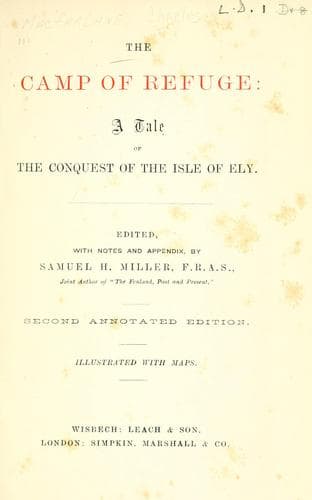
The Camp of Refuge: A Tale of the Conquest of the Isle of ElyMacFarlane, Charles
History
The Camp of Refuge: A Tale of the Conquest of the Isle of Ely
MacFarlane, Charles
Great Britain -- History -- Medieval period, 1066-1485 -- Fiction
“The wrath of the Lord will overtake thee for this ribaldry! Oh,
Hereward of Brunn, we will not break bread with thee, nor sit at the
table with such as thou art.”
“Then stay here where ye are, and munch your dry bread to the odour of
our roast meats,” said the young Lord of Brunn.
And so, leaving the false monks under guard of some of his merry men,
Hereward with the true monks went straight to the refectory and fared
sumptuously; and then, like the bounteous lord that he was, he made all
his followers, of whatsoever degree, eat, drink, and be merry; and so
heartily did these true Saxons eat and drink, that of that same feast
they left nothing behind them for Torauld of Fescamp and his hungry
Normans. And when it was time to get gone, and they could drink no
more, Elfric and sub-sacrist went down to the cellars and set every
cask running, to the end that there should not be a drop of wine or a
drop of ale or a drop of mead to cool the throats of the disappointed
Frenchmen.
Then the Lord of Brunn and his merry men all took their departure from
the abbey of Peterborough, taking with them the chalices and pateras,
the crosses and candelabra, the shrine-plates and the reliquaries, the
diadems and the tables, the linens, the silks, and hangings, and
everything that was worth taking, and everything that Torauld of
Fescamp and his men-at-arms most wanted to find and seize. And thus did
the great house of Peterborough cease to be called the rich and begin
to be called miserably poor, _de aurea erat pauperrima_.[178]
Public-domain text, read in full here on John Shaqi.
Reviews
Reviews
No reviews yet
Be the first to share your thoughts on this work.
Elsewhere in the archive
Join the Discussion
Join the discussion
Sign in to leave a comment or review.
Sign InorCreate an account