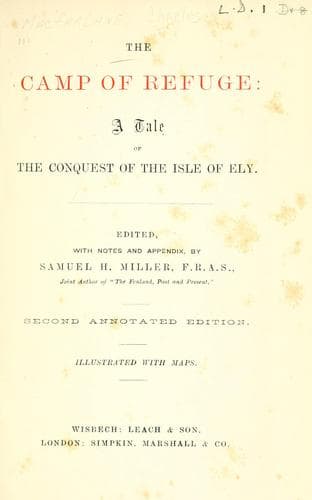
The Camp of Refuge: A Tale of the Conquest of the Isle of ElyMacFarlane, Charles
History
The Camp of Refuge: A Tale of the Conquest of the Isle of Ely
MacFarlane, Charles
Great Britain -- History -- Medieval period, 1066-1485 -- Fiction
The Ladie Alftrude, and sundry other persons, thought and said that
Lord Hereward had done enough for this one night; but the Lord of Brunn
thought he had never done enough when there was more to do, and before
Ivo Taille-Bois could get clear out of the wood, Hereward was upon his
track, with fifty of his merry men. Some of the Normans, missing the
ford across the stream, were captured on the bank; but the rest got
safely over, and ran for their lives across the plain, whereon they
never could have run at all if the summer had been less hot and dry.
They were closely followed by the Saxons, who took a good many more of
them, and killed others: but Ivo was too far ahead to be caught; and it
was all in vain that Hereward shouted and called upon him to stop and
measure swords with him on dry ground, and on a fair field. So the Lord
of Brunn gave up the pursuit, and returned to his manor-house, taking
with him a good score more prisoners. And if the louts who had been
sent to keep guard at Edenham had not gone to Corby wake, and had not
drunk themselves drunk there, Ivo Taille-Bois would have been captured
or killed, with every man that followed him, before he could have got
out upon the road which leads from the fen country to Stamford. The
rest of that night was given to festivity and joy. On the morrow
morning Hereward brought his Norman captives forth from the turret into
the great hall, and made inquest into their names and qualities. There
were several knights of name among them; several that had high rank and
good lands in Normandie before ever they came to plunder England. Now
these proud foreign knights condescended to address the Lord of Brunn
as one of the military confraternity, and they spoke with him about
ransom as knight speaks to knight. Hereward, knowing well how the Abbat
of Ely had been constrained to lay hands on that which had been offered
on the shrine of the saints, and to deal with unbelieving and usurious
Jews, and how sorely money was needed throughout the Camp of Refuge,
did not gainsay these overtures about ransoms; but he fixed the total
ransom at so high a price, that Torauld and the Norman knights all
vowed that they could never pay or get their friends to pay it. The
Lord of Brunn, who believed them not, told them that they must pay the
three thousand marks he had named, or live and die in the fastnesses of
the fen country. Torauld who loved money more than he loved his own
soul, and who never doubted but that Hereward had all the treasures he
had taken from Peterborough, and meant to keep them for his own use and
profit, offered, as lawful superior of that house, and abbat appointed
by King William, to give the Lord of Brunn a title to all those things
as the price of the ransom for himself and the Norman nobles. But
hereat the Lord of Brunn was greatly incensed, and said, “Robber that
thou art, dost thou take me for a sacrilegious robber? The treasure of
Public-domain text, read in full here on John Shaqi.
Reviews
Reviews
No reviews yet
Be the first to share your thoughts on this work.
Elsewhere in the archive
Join the Discussion
Join the discussion
Sign in to leave a comment or review.
Sign InorCreate an account