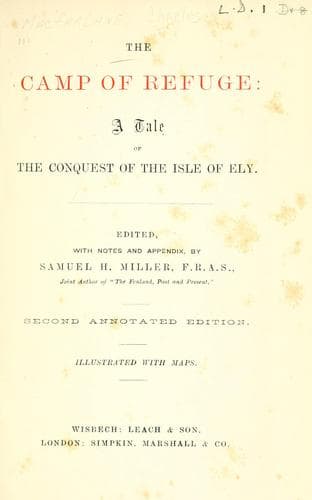
The Camp of Refuge: A Tale of the Conquest of the Isle of ElyMacFarlane, Charles
History
The Camp of Refuge: A Tale of the Conquest of the Isle of Ely
MacFarlane, Charles
Great Britain -- History -- Medieval period, 1066-1485 -- Fiction
Peterborough is not here, but at Ely,[183] in the safe keeping of the
good Lord Abbat Thurstan, to be kept or even used for the good of
England, and to be restored to Peterborough with bot, and with other
treasure, at the proper season. But thou, oh Torauld of Fescamp, thou
hast no right to it, or control over it; and if thou hadst it, it is
not my father’s son that would barter with thee for the goods of the
church and the spoils of the altar! Torauld of Fescamp, and thou Piron
of Montpinchon, and thou Olivier Nonant, and thou Pierre of Pommereuil,
and the rest of ye, I tell ye one and all, and I swear it by the
blessed rood, that I will never liberate ye, or any of ye, until the
three thousand marks, as ransom, be paid into my hands, or into the
hands of the Lord Abbat of Ely! So, look well to it. Three thousand
marks, or a lifelong home and a grave in the safest and dreariest part
of the fens.”
One and all, they again protested, and even vowed that so large a sum
could never be raised for their liberation; and that they would not so
much as name the sum to their friends and families.
“Well,” said the Lord of Brunn, “then to-morrow we will clap ye all on
ship-board and send ye across the salt sea Wash for Ely and the Camp of
Refuge.”
And on the morrow, by times, all the Norman captives, gentle or simple,
knights or men-at-arms, were marched off to the Welland and put on
board ship and under hatches: nor ever did they get free from their
Saxon prison in the fens until twelve good months after their capture,
when they got the money, and paid down the three thousand marks,
together with some small pecunia for their meat and drink, and the
trouble they had given during their captivity. And long did Torauld
bemoan the day when he accepted the office of abbat of Peterborough,
and went to take vengeance on that house on account of Lord Hereward’s
knighthood. He came forth from the fens an altered and subdued man; and
although he tyrannically ruled a religious house for many years after
these his misadventures, he was never more known to tweak his monks by
the nose with his steel gloves on, or to beat them with the flat of his
sword, or to call out “Come hither, my men-at-arms.” In truth, although
he plucked up spirit enough to rob and revile monks, he never put on
armour or carried a sword again.
Public-domain text, read in full here on John Shaqi.
Reviews
Reviews
No reviews yet
Be the first to share your thoughts on this work.
Elsewhere in the archive
Join the Discussion
Join the discussion
Sign in to leave a comment or review.
Sign InorCreate an account