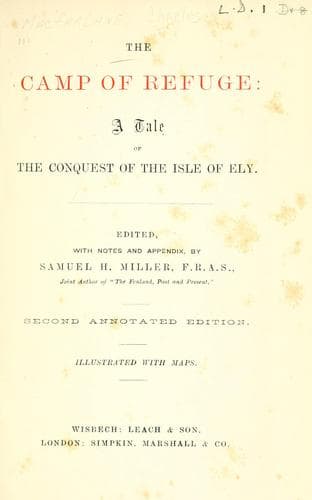
The Camp of Refuge: A Tale of the Conquest of the Isle of ElyMacFarlane, Charles
History
The Camp of Refuge: A Tale of the Conquest of the Isle of Ely
MacFarlane, Charles
Great Britain -- History -- Medieval period, 1066-1485 -- Fiction
with Abbat Thurstan and the Saxon chiefs at Ely, to spy into the
condition of the Camp of Refuge, and to invite the Lord Abbat and some
of the great chiefs to come down to Lynn, in order to hold there a
solemn conference with his jarls and chiefs. The messenger-bark
proceeded on her voyage prosperously, and landed the cunning Dane at
Ely. Good Abbat Thurstan wondered and grieved that the prince had not
come himself; yet he bade his envoy welcome, and feasted him in his
hall. But still more did Thurstan wonder and grieve when he was told
that Knut meant not to come to Ely, but was calling for a congress at
Lynn.
“There may be danger,” said the Lord Abbat to the cunning old envoy,
“if I quit this house, and the great thanes leave the Camp of Refuge,
though only for a short season; but there can be no peril in thy
prince’s coming hither, and assuredly it is only here that we can
entertain him as the son of a great king ought to be entertained.”
The old Dane said that the prince his master had schemes of operation
which would not allow him to send his ships up the Ouse for this
present; that he would come hereafter, when good progress should have
been made in the war against the Normans; and that in the meanwhile it
were best for my Lord Abbat, and some other of the prelates, and some
of the great lay lords, to go down to Lynn and hold a conference, and
make a combined plan of operations with the prince and the jarls.
Much did the Saxon lords wish to make out what was the nature of the
plan the prince had already adopted; but the astutious old envoy would
tell them nothing, and protested that he knew nothing about it. The
Saxons plied him hard with wine; but the more he drank, the more close
the old Dane became. And although he would tell nothing himself, he
wanted to know everything from the English: as, what was the strength
of their army in the Camp of Refuge—what their means of
subsistence—what the names of all their chiefs—what their
correspondence and alliance with other Saxon chiefs in other parts of
England—what the strength of the Normans in various parts of England,
and which the provinces and the chiefs that had entirely submitted to
them, with many other particulars. It was too confiding, and indeed
very unwise so to do; but the Saxons, albeit often betrayed before now,
were not much given to suspicion, and so they satisfied him according
to the best of their knowledge on all these points, and conducted him
into their camp that he might see with his own eyes how matters stood
there, and afforded him all possible opportunities of judging for
himself as to the means they had in hand, and the chances they had of
successfully terminating a struggle which had already lasted for years.
The crafty old man thought the nakedness of the land much greater than
it really was, and he afterwards made a report conformably to Knut his
master and prince. Yet, on the morrow morning, when he was about to
Public-domain text, read in full here on John Shaqi.
Reviews
Reviews
No reviews yet
Be the first to share your thoughts on this work.
Elsewhere in the archive
Join the Discussion
Join the discussion
Sign in to leave a comment or review.
Sign InorCreate an account