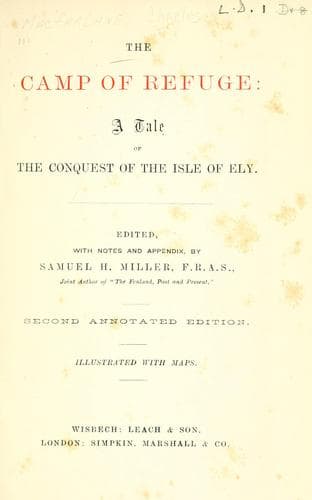
The Camp of Refuge: A Tale of the Conquest of the Isle of ElyMacFarlane, Charles
History
The Camp of Refuge: A Tale of the Conquest of the Isle of Ely
MacFarlane, Charles
Great Britain -- History -- Medieval period, 1066-1485 -- Fiction
of the Anglo-Saxons was on foot, the hearts of the Danes rejoiced in
the prospect of good booty, even as the hearts of the coast-dwelling
people rejoice when they hear that a rich wreck or a large fat whale
hath been stranded near to their doors. King Svend Estrithson, of a
certainty, would have gone himself[191] into England with the fleet,
but his royal shield fell to the ground and broke as he was lifting it
down from the wall, and a hare crossed his path as he was walking in
his garden, and the priest his chaplain sneezed three times while he
was saying mass before him, and he was greatly enamoured of the
Princess Gyda,[192] and in consequence of all these evil omens the king
resolved to stay at home, and to send his eldest son Knut into
England.[193] Taking with him the royal standard of the black raven,
and many jarls of high renown into his own ship, Knut began his voyage
forthwith, being followed by two hundred and fifty keels, large and
small. The royal ship was rich and splendid; it had thirty benches of
rowers; its prow was adorned with a dragon’s head, the eyes of which
were of precious stones and the tongue of red gold; and the sides and
the stern of the ship glowed with burnished gold; the whole body of the
ship glittered in the sun like some great and marvellous fish or some
swimming dragon; and, in sooth, the whole ship was dragon-shaped. The
masts and the cordage and the sails were surpassing rich and gay; the
masts were covered with ivory and pearl, the cords seemed to be covered
with white silk, and the sails were of many and bright colours. There
were cloths of gold spread all about, and the flag that waved at the
mainmast-head was all of silk and gold; and the windlass and the rudder
were bepainted with blue and gold. And on board this right royal ship
every warrior wore bright steel-chain armour, and carried a shield and
battle-axe inlaid with gold and jewels, and each of value enough to
purchase a hide of land. A few other ships there were in this great
fleet only a little less splendid than that of Knut. The rest were of a
coarser make, and with no adornments about them except the figure-head
at the prow and the banner at the mast-head; and they varied in size
and burthen from the great ship which could carry two hundred fighting
men, down to the little bark which carried but ten. To speak the truth,
many of the fleet were little better than fishing barks. The summer
wind blew fresh and fair for England, the waves seethed before their
prows, and on the morning of that glad evening at Brunn when Lord
Hereward captured Torauld of Fescamp and put Ivo Taille-Bois to flight
and shame, nearly the whole of the great fleet came to anchor off the
Wash, and not far from the chapel of our Ladie. Knut, the king’s son,
being uncertain and suspicious, like one that had treacherous plans in
his own mind, despatched one of his smallest and poorest keels with a
crafty and keen-sighted chief up the Wash and up the Ouse, to confer
Public-domain text, read in full here on John Shaqi.
Reviews
Reviews
No reviews yet
Be the first to share your thoughts on this work.
Elsewhere in the archive
Join the Discussion
Join the discussion
Sign in to leave a comment or review.
Sign InorCreate an account