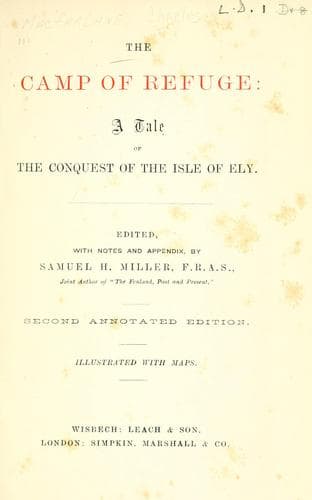
The Camp of Refuge: A Tale of the Conquest of the Isle of ElyMacFarlane, Charles
History
The Camp of Refuge: A Tale of the Conquest of the Isle of Ely
MacFarlane, Charles
Great Britain -- History -- Medieval period, 1066-1485 -- Fiction
Knut, the son of the king of Danemarck, standing on his proud gilded
ship, received the English prelates and chiefs with great stateliness,
yet not without courtesy; and when the silken purse and the scrapings
of the shrine-treasures had been presented to him (Thurstan blushing
the while), he sat down with his jarls on one side of a long table, and
the Englishmen sat down on the opposite side; and then the conference
began. Unhapily for the English landsmen a summer storm began to blow
at the same time, causing the royal ship to roll, and thus making them
feel the terrible sickness of the sea. At this Thurstan almost wished
that he had let the prior come, instead of coming himself. Knut, the
prince, spoke first in a very few words, and then his jarls further
propounded and explained his plan of the war. The Danes indeed had
nearly all the talking to themselves, for not many of them understood
what the English said, or had patience to hear it interpreted; the
qualms and sickness of the English almost took away their power of
speech, and, moreover, they very soon discovered that nothing they
could say had any effect in altering the opinions and decisions of the
predetermined Danes. It was grievous, they said that the English, who
had been so rich, should now have so little money to share with their
friends and deliverers! They hoped that the good prelates and lords
would be able to hold out in the isle of Ely and throughout the fen
country; and as they had held out so long, no doubt they could hold out
longer. In the meanwhile they, their good allies the Danes, would
divide their fleet, and scour all the coast, and sail up all the great
rivers, for this would distract the attention of the Normans, would
alarm them at one and the same time in many different and distant
places, and infallibly compel them to recall their forces from
Cam-bridge and Stamford, and to give up all premeditated attacks on the
fen country.
“Aye,” said a sea-rover, whose yellow hair had grown as white as snow
with excess of age, and whose sunken eye glistened at the memory of
past adventures of that sort, “Aye, Saxons! we will sweep all this
eastern coast from north to south and from south to north, as with a
besom! We will sail or row our barks up every river that flows into the
sea on this side of your island, and that hath keels on its waters or
towns on its banks. Tweed, Tyne, and Humber, Trent, Orwell, Stour, and
Thamesis, with all the rivers that run between them or into them, shall
hear our war-cry as of yore!”
“But, alas!” said one of the Saxon lords, “who will suffer in this kind
of war but the Saxons? The Normans have very few ships. The ships on
the coast and on the rivers, and the townships and hamlets, are all
English still, and cannot be seized or destroyed without ruin to us and
the cause which the king of Danemarck hath engaged to support.”
Public-domain text, read in full here on John Shaqi.
Reviews
Reviews
No reviews yet
Be the first to share your thoughts on this work.
Elsewhere in the archive
Join the Discussion
Join the discussion
Sign in to leave a comment or review.
Sign InorCreate an account