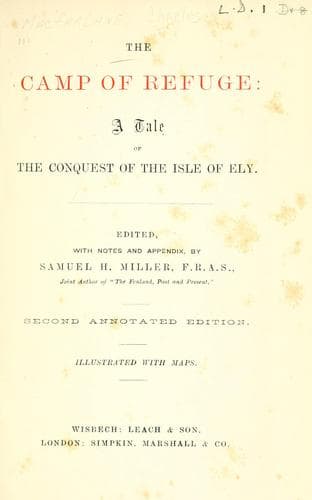
The Camp of Refuge: A Tale of the Conquest of the Isle of ElyMacFarlane, Charles
History
The Camp of Refuge: A Tale of the Conquest of the Isle of Ely
MacFarlane, Charles
Great Britain -- History -- Medieval period, 1066-1485 -- Fiction
The old sea-rover was silent, and the other Danes pretended not to
understand what the Saxon lord said. Abbat Thurstan told the prince
that of a surety the Saxons in the Camp of Refuge could continue to
defend themselves; but that they could do still better if the Danes
would spare them some arms and other warlike harness, and remain for a
while in the Wash and in the rivers which empty themselves into it, in
order to co-operate with the Saxons. Knut, who well knew that there was
nothing to be picked up in those waters, shook his head, and said that
his own plan was the best, and could not be altered; and that, touching
the matter of arms and harness, he had none to spare, but that he would
send over to the Netherlanders’ country and buy, _if_ the Saxons would
give him the money. Here the abbat and the Saxon lords were silent. But
when Knut spoke of the great losses which the Danes had suffered in the
foundering of their return fleet the year before,[194] Thurstan
reddened and said, “The Jarl Osbiorn acted a traitorous part, and hath
been treated as a traitor by his brother and king. That loss was the
direct judgment of Heaven! The fleet was loaded with the spoils of
England and with the money taken from the Norman for betraying the
English! Prince, and jarls all! if ye be come to do as Osbiorn did last
year, I say look to your fleet, and look to the health of your own
souls!”
Hereupon Knut and his great chiefs began to cross themselves, and to
make many promises and protestations; and then the prince called for
wine and pledged the Lord Abbat of Ely and the other English lords, lay
and ecclesiastic, severally: and when they had all drunk wine, he broke
up the conference and dismissed them in a very unhappy state both of
mind and of stomach, for the storm had increased, and the wine was sour
and bad. The royal Dane hauled in his anchors and set sail to get out
of the Wash and from among the dangerous sandbanks. As soon as the
Saxon lords got ashore at Lynn, and free from their exceeding great
sickness, Thurstan said that he greatly feared a woeful error had been
committed in inviting the Danes back again, and that a short time would
show that the Lord of Brunn had been quite right in recommending the
Saxons to trust to their own arms and efforts for their independence;
but those lords who had voted for the invitation said that it was clear
the Danes would have come back whether they had been invited or not,
and that it was equally clear that England could not be saved without
the aid of some foreign nation. These lords also thought that a crowned
king like Svend Estrithson would not break his royal word, and that the
prince his son would not act like Osbiorn, albeit he might, in the
ancient manner of the Danes, be too eager to scour the seas and rivers
and capture whatever he might find, whether it belonged to friend or
foe, to Saxon or to Norman. Yet, truth to say, these lords were far
Public-domain text, read in full here on John Shaqi.
Reviews
Reviews
No reviews yet
Be the first to share your thoughts on this work.
Elsewhere in the archive
Join the Discussion
Join the discussion
Sign in to leave a comment or review.
Sign InorCreate an account