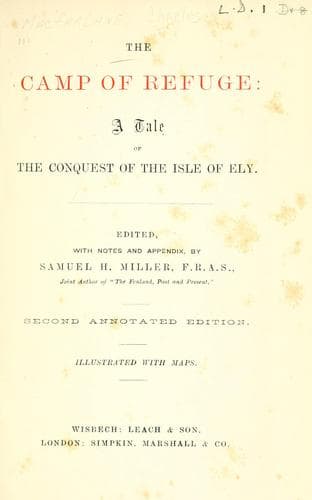
The Camp of Refuge: A Tale of the Conquest of the Isle of ElyMacFarlane, Charles
History
The Camp of Refuge: A Tale of the Conquest of the Isle of Ely
MacFarlane, Charles
Great Britain -- History -- Medieval period, 1066-1485 -- Fiction
Even while he was lying in the river Thamesis[199] with his great
fleet, and was seeming to threaten the Tower of London, Knut received
on board envoys and rich presents from Duke William, and was easily
made to sign a treaty of amity and alliance with the Normans, even as
his uncle Osbiorn had done the year before. And did the traitorous
Danes enjoy the spoil they had gotten? Not so. When they got into the
middle of the sea there arose a violent storm and dispersed the ships
wherein were lodged the spoils made at Ely[200] and at other places,
and some of these ships went to Norway, some to Ireland, and some to
the bottom of the sea; and all of the spoils of Ely and Peterborough
that reached Danemarck consisted of a table and a few reliquaries and
crucifixes; and these things, being deposited in the church of a town
belonging to King Svend, were consumed by fire, for the careless and
drunken shipmen set fire to the town and church by night,[201] and so
caused the loss of much more treasure than that which the shipmen had
brought with them from England. The amount of the total treasure paid
to Knut by Duke William was never known with any certainty in England,
out of the very vitals of which it was torn; but it is known in another
place, where all these acts of treachery are recorded, and heavily will
it press upon the soul of Knut, and upon the selfish soul of his
father, Svend Estrithson, who ratified the foul bargain he had made.
And, even in this world, hath not the avenging hand of Heaven smitten
them twain? Hath not the excommunication of the holy church fallen
twice upon Svend? Hath not unnatural warfare raged long between the
sons of Svend, and hath not Knut been murdered in his prime—aye,
murdered, in a church, to which he fled for sanctuary? He had offended
the saints by his broken faith, and by plundering the shrines in
England; and therefore no shrine or altar could save him from the
treachery and malice of his own subjects.
All the evils done to England by Knut and his Danes are not yet told,
but they will plainly appear hereafter.
CHAPTER XIX.
THE NORMAN WITCH.
Public-domain text, read in full here on John Shaqi.
Reviews
Reviews
No reviews yet
Be the first to share your thoughts on this work.
Elsewhere in the archive
Join the Discussion
Join the discussion
Sign in to leave a comment or review.
Sign InorCreate an account