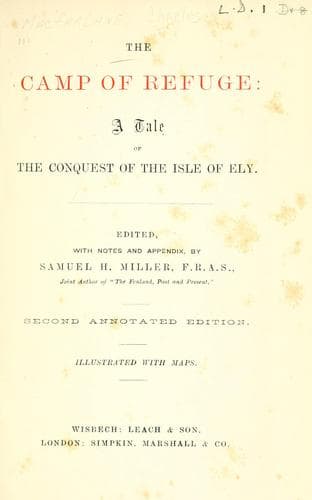
The Camp of Refuge: A Tale of the Conquest of the Isle of ElyMacFarlane, Charles
History
The Camp of Refuge: A Tale of the Conquest of the Isle of Ely
MacFarlane, Charles
Great Britain -- History -- Medieval period, 1066-1485 -- Fiction
So the Danes and their ships were gone with all that they could carry
with them; and the Saxons of Ely and in the Camp of Refuge, after being
robbed as well as betrayed, were left to their own devices. Much was
Duke William heartened by the departure of Knut, and the treaty he had
made with him; and, seeing no enemy in any other part of England, he
gave his whole mind to the war in the Fen-country. More knights and
adventurers had come over from France and from sundry other countries
to aid the Conqueror in his enterprises, and to seek provision and
fortune in unhappy England. Choosing some of the best of these new
comers, and joining them to troops that had been tried in the hard
warfare of the Fen-country, the Son of Robert the Devil by the harlot
of Falaise sent strong garrisons to Grantham and Stamford, and
Peterborough, and Cam-Bridge; and, carrying with him his chancellor and
nearly the whole of his court, he quitted London and went himself to
Cam-Bridge to direct the war in person. As he and his mighty great host
were marching through the country towards the river Cam, and as the
poor Saxon people counted the number of the lances, they said,
“_Miserere Domine!_ The conquest of our country is complete, and not
even Hereward the Brave will be able longer to defend the Camp of
Refuge!”
When Duke William arrived in the camp at Cam-Bridge, and examined the
Fen-country which lay before him, he severely censured the folly and
rashness of Eustache of Ambleville; and also chiding the impatient and
self-confident knights that were now with him and eager to fall on, he
swore his terrible oath, by the splendour of God’s face, that he would
not allow of any fighting until the ancient causeway[202] should be
repaired and fortified with towers, and another and a broader causeway
carried across the marshes into the very heart of the fens, and
opposite to the point whereon the Saxons had constructed the main
defence of their Camp of Refuge. Timber and stones and baked bricks
were brought from all parts of the country, and every Saxon serf that
could be caught was impressed, and was forced to labour almost unto
death upon works intended for the destruction of his countrymen.
Skilful artizans and men experienced in the making of roads and the
building of bridges were brought to Cam-Bridge from the city of London,
from the city of Caen in Normandie, and from other places beyond the
seas; and the task which William had in hand was made the easier by the
long-continued, unwonted dryness of the season. But the Lord of Brunn,
although he prayed heartily for rain, did in no wise lose heart; and in
proportion as his difficulties increased, his wit and invention
increased also. The working parties on the roads were constantly
covered and protected by great bodies of troops put under the command
of vigilant officers; but this did not prevent Hereward from stealing
through the tall, concealing rushes of the fens, and the forests of
Public-domain text, read in full here on John Shaqi.
Reviews
Reviews
No reviews yet
Be the first to share your thoughts on this work.
Elsewhere in the archive
Join the Discussion
Join the discussion
Sign in to leave a comment or review.
Sign InorCreate an account