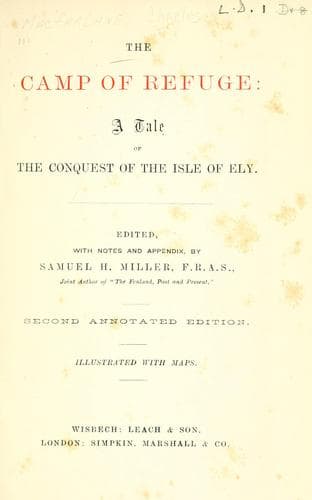
The Camp of Refuge: A Tale of the Conquest of the Isle of ElyMacFarlane, Charles
History
The Camp of Refuge: A Tale of the Conquest of the Isle of Ely
MacFarlane, Charles
Great Britain -- History -- Medieval period, 1066-1485 -- Fiction
Once in flying through the air to the
hellish sabbat at Beneventum she came too near to the cross of Saint
Peter’s Church at Rome, and so fell to the earth.
Ivo Taille-Bois,[206] profane man as he was, would have turned with
horror from the witch, but in his sinful ignorance he believed that the
devil’s arts might be employed against the devil, and he saw that all
the soldiery, nay, and all the chivalry put under his command, believed
that without witchcraft they could never cope with the Lord of Brunn,
nor make any way in the Fen-country. As for the witch herself, she
promised the men immediate and most marvellous victories. Therefore it
was agreed that she should go forth with the troops and the working
parties and penetrate into the fens, and that she should take her
station on a high wooden tower, and thence give her directions as well
to the working men as to the fighting men. Now Lord Hereward and
Girolamo of Salerno, being advised of the arrival of the hag and of the
plans of the Normans, took counsel together, and trusted, with the aid
of the saints, to break the spell and sortilege, and consume the witch
while in the very act of her witchcraft. Calling in his merry men from
all their outposts, and posting them behind a river, Lord Hereward
allowed the Normans to advance a good way into the fens, and he offered
them no molestation while they were building a lofty wooden tower in
the midst of an open plain. But when the tower was finished and the
witch was at her incantations, and when the Norman band was gathered
round the foot of the tower in that open plain, Hereward and Girolamo,
aided only by Elfric and a few other alert Saxons, came round unseen to
the edge of the plain and set fire to the dense reeds and rushes that
grew upon it. It is the custom of the fenners to burn their reeds and
stubble in the month of November of every year in order to fertilize
the soil with the ashes thereof; and at this season one sees all this
moorish country in a flame, to his great wonder and surprise, if he be
a stranger in these parts. It was now the burning-time, and owing to
the exceeding dryness of the summer and of the autumn likewise, the
reeds and junci in this plain were all as dry as matches: add to this
that the Saleritan had brought with him and had sprinkled over the
plain some of his marvellous compounds which made a raging and
inextinguishable fire, and that the wind was blowing keenly from the
north-east right across the plain and towards the tall wooden tower,
and then it may be, to some degree, imagined, how rapidly and awfully
the flames, once lit, rolled over that broad open field, crackling, and
hissing, and then roaring in the wind, while columns of thick, pungent,
suffocating smoke rolled after them, darkening the sun and sky and
making visible the horrible red glare. At the first glimpse of the
mighty blaze the hag stopped her incantation and let the hell-broth she
Public-domain text, read in full here on John Shaqi.
Reviews
Reviews
No reviews yet
Be the first to share your thoughts on this work.
Elsewhere in the archive
Join the Discussion
Join the discussion
Sign in to leave a comment or review.
Sign InorCreate an account