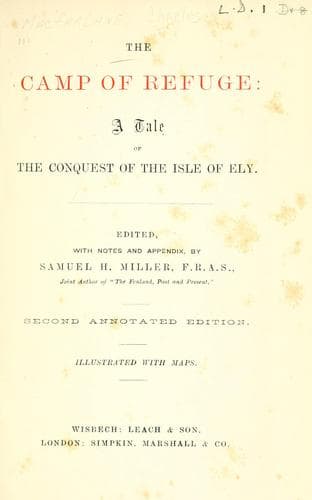
The Camp of Refuge: A Tale of the Conquest of the Isle of ElyMacFarlane, Charles
History
The Camp of Refuge: A Tale of the Conquest of the Isle of Ely
MacFarlane, Charles
Great Britain -- History -- Medieval period, 1066-1485 -- Fiction
season did not suit Duke William, certain at least it is that he fell
sick of a fever and ague, and thereupon took a hurried departure from
Cam-Bridge and travelled towards London, having first sent to call from
Stamford town Ivo Taille-Bois to take the command of the great army.
Now, when Ivo came to Cam-Bridge, and when Duke William was away in
London, matters went far worse with the Normans than before, for the
Viscomte was not a great captain, as the Duke assuredly was. Moreover,
many of the troops took the ague, and others were so unmanned by their
fears that they could never be made to stand their ground; and, in
fine, all vowed that they would not venture among the woods and
bulrushes, nor attempt any feat of arms whatever until the great witch
should arrive from Normandy to countervail the black arts of the
Salernitan and the other wizards and witches they falsely believed to
be employed by the pious Lord of Brunn.
At last a terrible Norman witch[203] arrived at Cam-Bridge, and she was
received in the entrenched camp and in the castle with transports of
exceeding great joy. Loathsome and wicked at the same time were it to
describe the person and features, the attire and demeanour, the spells
and incantations of this frightful and detestable portentum. Her years
far exceeded the ordinary length of human life, and they had all been
spent in sin and in the practise of infernal arts: in sin and actual
devilry had she been conceived and born, for her mortal father was none
other than that arch-heresiarch and enemy to the saints, Leutarde of
Vertus, in the bishopric of Chalons, who went about with a
sledge-hammer breaking the images of God’s saints, and preaching that
God’s prophets had not always prophesied the truth, and that God-living
servants and ministers of the altar had no right to their tithes! Since
the day when her sire, pursued by his bishop, cast himself head
foremost into a deep well and was drowned (for the devils, in their
compact with him, had only agreed that he should never be burned), this
foul strega, his only daughter, had wandered over the face of the wide
earth doing mischief, and dwelling most in those forsaken, accursed
parts of the earth where witchcraft does most flourish. It was said
that she had been as far north as that dread isle which is covered with
snow, and which yet is for ever vomiting smoke and flames; even to that
northern isle[204] which pious men believe to be one of the entrances
into hell, and which has been notoriously inhabited at all times by
devils and devil-worshippers; that she had lived among the Laps, who
call up demons by beat of drum; and that she had dwelt in the
Orcades,[205] where the devil’s dam and her handmaidens use to raise
great storms, and to sell wind foul or fair. Of a surety was there no
witch of all that congregated round the witch-tree of Beneventum more
known than this! It was known, too, how she came by that broken leg
which made her limp in her gait.
Public-domain text, read in full here on John Shaqi.
Reviews
Reviews
No reviews yet
Be the first to share your thoughts on this work.
Elsewhere in the archive
Join the Discussion
Join the discussion
Sign in to leave a comment or review.
Sign InorCreate an account