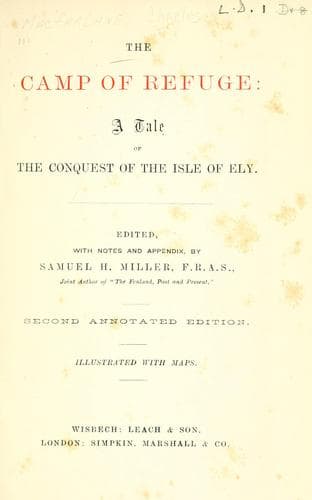
The Camp of Refuge: A Tale of the Conquest of the Isle of ElyMacFarlane, Charles
History
The Camp of Refuge: A Tale of the Conquest of the Isle of Ely
MacFarlane, Charles
Great Britain -- History -- Medieval period, 1066-1485 -- Fiction
engaged with Count Robert, the bold Lord of Brunn had his eye solely
upon him, and with men elate with victory was watching his approach,
even as he had long been watching and preparing for it. The broken old
road[210] was repaired, and the now diminished streams were made
passable by means of the wooden bridges which the Norman soldiers
carried or caused to be carried with them, and by throwing down stones,
and timber, and bricks, and dry earth in strong wooden frames, Duke
William, after three days of cruel labour and toils which killed many
of his people, got within sight of the deep waters of Ely, and caught a
distant view of the Witchford, where his Norman witch had crossed over.
But the ford was now guarded by a double castle, or double fort; the
one on this side of the stream, and the other on that; and the farther
bank and the plain beyond it seemed, as the duke approached a little
nearer, to be covered with a Saxon army, and with trophies taken from
the Normans. Onward, however, he went until he saw the banner of his
half-brother Count Robert held out over the wooden walls of the Saxons;
but then he understood full well what had befallen his people at
Wisbech; and so, like the persevering and prudent commander that he
was, he ordered an immediate retreat. But it passed his skill and his
might to conduct this retreat in a safe and orderly manner; the Normans
got confused, and Hereward, crossing at the ford, charged through thick
and thin, through bog and dry ground, and along the temporary causeway
which had been made: the bridges of wood broke down under excess of
weight; Duke William himself fell into deep water and was nearly
drowned, and many of his people were wholly drowned or smothered, while
many more were slain by the sword or taken prisoners. And still the
bold Saxons, as they followed, shouted “Hereward for England! Stop,
thou Bastard William! Thou art running as fast as thy brother Robert
ran from Castle Hereward!”
Public-domain text, read in full here on John Shaqi.
Reviews
Reviews
No reviews yet
Be the first to share your thoughts on this work.
Elsewhere in the archive
Join the Discussion
Join the discussion
Sign in to leave a comment or review.
Sign InorCreate an account