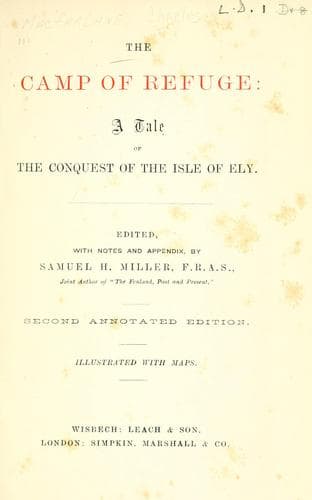
The Camp of Refuge: A Tale of the Conquest of the Isle of ElyMacFarlane, Charles
History
The Camp of Refuge: A Tale of the Conquest of the Isle of Ely
MacFarlane, Charles
Great Britain -- History -- Medieval period, 1066-1485 -- Fiction
After this misadventure Duke William judged more favourably of the
conduct of his many commanders who had failed in the same enterprise;
and seeing all the difficulties of the war, and the inexhaustible
resources of that cunning captain, the Lord of Brunn, he called a
council in the castle at Cam-Bridge, and there determined to try no
more battles and assaults, but to rely solely upon a close blockade of
the Isle of Ely. Forthwith orders were sent to all the commanders of
posts round the Fen-country (the dull-witted Count Robert was recalled
from Wisbech, and an abler captain sent to that vicinage) to strengthen
themselves in their several positions by building towers and walls, and
digging trenches, and by increasing the numbers of their men-at-arms;
but at the same time they were strictly commanded to make no movement
beyond the limits of their defensive works, however great the
temptation to attack the Saxons might be. The great fleet so long
collecting in the river Thamesis, and which was in good part composed
of English vessels which the Danes had captured and then sold to Duke
William, was sent round the coast well filled with fighting men, and
piloted by some of those Danish mariners and sea rovers who knew so
well all the bays and rivers on this eastern coast; and by the end of
the month of July, or a little before the Feast of Saint Ethelwold,
every station on the coast, from the mouth of the Orwell to the broader
mouth of the river Humber, was watched and guarded, and every estuary,
river, or creek that gave egress from the Fen-country was blocked up by
ships and barks, in such sort that the Saxons in the Camp of Refuge
could no longer have any communication with the sea, or with the
countries beyond the sea, from whence they had been wont to draw arms
and munitions of war, and corn, wines, and oil, and other supplies. By
the same means all aid and friendly intercourse were completely cut
off; the good Saxons dwelling in a sort of independence on the northern
shores of England, and the good Englishmen that had fled into Scotland,
could no longer send their barks up the Wash and the Ouse with
provisions and comfort for the house of Ely and the Camp; and thus the
whole Isle of Ely was cut off, by land and by water, from all the rest
of the world, and was girded by a mighty chain, the links of which
seemed every day to grow stronger.
Public-domain text, read in full here on John Shaqi.
Reviews
Reviews
No reviews yet
Be the first to share your thoughts on this work.
Elsewhere in the archive
Join the Discussion
Join the discussion
Sign in to leave a comment or review.
Sign InorCreate an account